
Custom GPTs vs Projects vs Email Courses
Custom GPTs vs Projects vs email courses: when to use a chatbot wrapper, a file pack, or a sourced, self-hosted email curriculum you will actually finish.

Muhammad Abdul Sami
· 11 min read
- Custom GPTs
- Learning
- Email Courses
- AI Productivity
Custom GPTs vs Projects vs email courses is the decision most professionals actually face after the novelty of chat wears off: should this knowledge live in a chatbot wrapper, a vendor “Project,” or a sequence that shows up in email with citations? This guide is for people who are not ML engineers — operators, managers, coaches, and owners who keep rebuilding the same instructions.
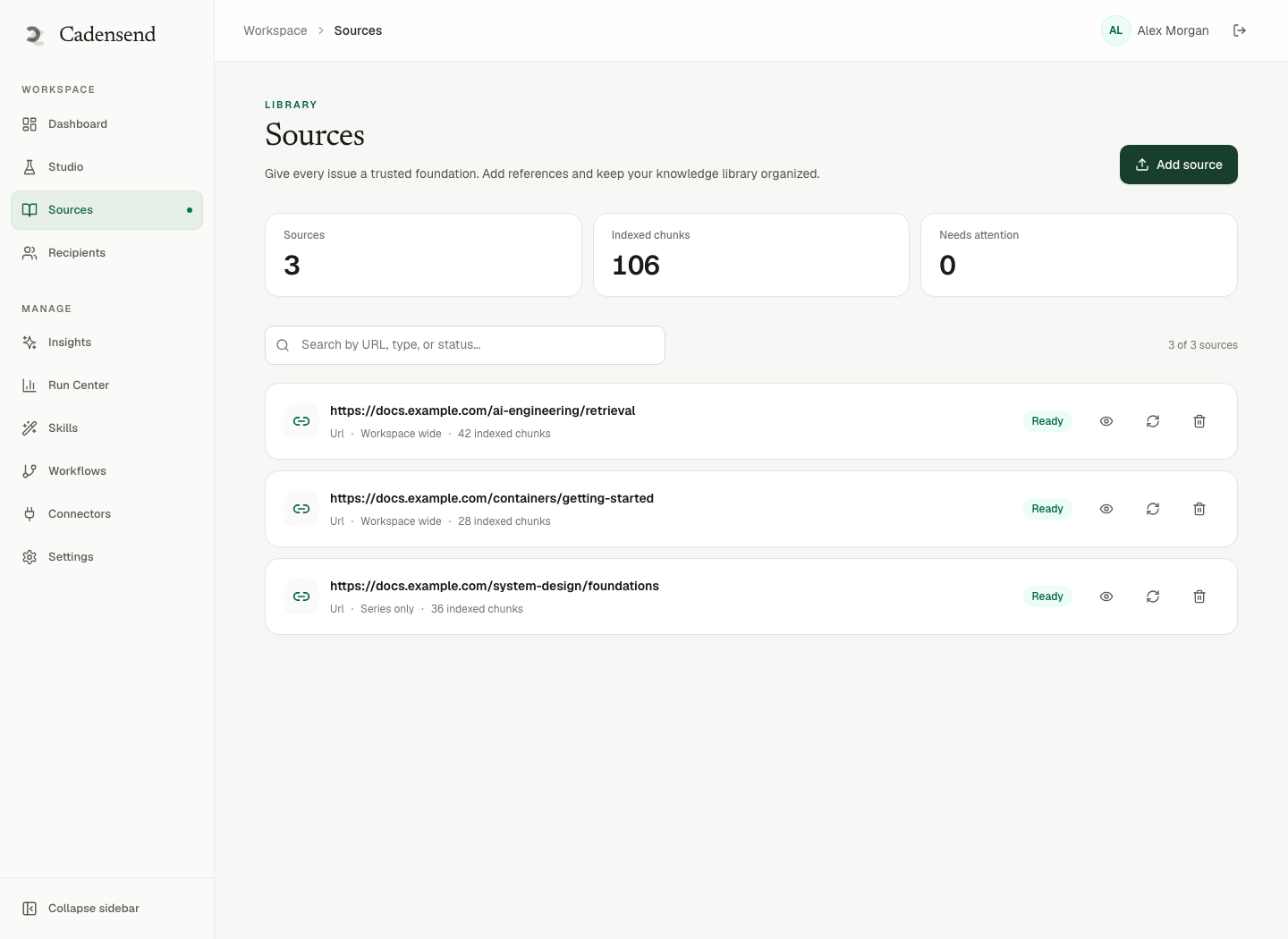
At HinterBuild we built Cadensend because neither a Custom GPT nor a cloud Project is a curriculum. Cadensend is an MIT-licensed, self-hosted email curriculum engine with no hosted signup. It turns one learning goal into a planned series, writes each issue grounded in sources you supply with real citations, and delivers exactly once (GitHub).
Key Takeaways:
- A Custom GPT is a reusable instruction plus optional files — great for a template, weak as a source of truth.
- A Project (ChatGPT/Claude-style) is a durable pack for a job you repeat this month.
- An email course is push + pacing + a finish line; grounding is optional unless you demand it.
- If claims must trace to your PDFs, prefer a sourced series or a retrieve-and-quote chat — not a personality.
- Privacy and retention follow the vendor unless you self-host.
- Pick the thinnest object that changes behavior next week.
Table of Contents:
- The three objects
- Decision table
- Custom GPTs in real work
- Projects as a fact pack
- Email courses — generic vs grounded
- Cadensend’s niche
- Migration paths
- Instructions that keep a GPT honest
- Evaluate a wrapper in 20 minutes
- Frequently Asked Questions
The three objects
Custom GPT (OpenAI and imitators). You write instructions, optionally upload files, optionally enable tools. Anyone with the link (or your workspace) chats with a character. Official overview: OpenAI GPTs.
Project. A named workspace with files and instructions that persist for you (and sometimes a team). Anthropic’s Projects and ChatGPT’s projects fill this slot. Less “character in a store,” more “this client’s pack.”
Email course. A sequence of issues on a cadence. Classic marketing courses are vibe-heavy. A grounded course cites sources and can be self-hosted.
These sit on top of daily chat. For which daily model, see ChatGPT vs Claude vs Gemini. None of the three objects replace a second brain. They read it or drip it.
Decision table
| Need | Custom GPT | Project | Generic email course | Grounded self-hosted series (Cadensend) |
|---|---|---|---|---|
| Reuse a writing template | Yes | Yes | No | Overkill |
| Keep this month’s client files together | Awkward | Yes | No | No |
| Teach 12 ideas over 12 days | Weak | Weak | Yes | Yes |
| Cite my PDFs in each lesson | Unreliable | Better if you paste | Rare | Designed for it |
| No new SaaS landlord | No | No | Depends | Yes (self-host, MIT) |
| Team without another chat login | Link chaos | Seat required | Inbox they have | Inbox they have |
| Finish line | Never | Never | Yes | Yes |
| Risk of invented extras | High | Medium | High | Lower if citations enforced |
Use the table honestly. A coach who wants a bot that “sounds like me” still needs a pack for facts. A manager who wants status quality needs a status procedure, not a GPT named “Chief of Staff.”
Custom GPTs in real work
Good GPTs
- “Rewrite this bullet; do not add numbers” for job applications
- “Extract tasks with quotes” for voice notes
- Brand-voice wrapper around your pasted brief
Bad GPTs
- “Company brain” with 40 stale PDFs and no quote rule
- HR bot that answers policy from memory
- Anything that sends email or files tickets without a gate
GPTs shine as UI for a prompt. They rot as systems of record. When the file is silent, the personality fills in — the same hallucination problem as stop AI making up facts in reports and LLM hallucination causes and fixes.
The GPT store also creates supply-chain risk: you do not know what instructions a third-party GPT hides. That is cousin to prompt injection. Prefer GPTs you wrote.
Privacy: uploaded files follow OpenAI’s current plan terms. Do not upload passports. Privacy-safe documents and PII scrubbing.
Projects as a fact pack
Projects are the right shape for:
- One client, one quarter
- One board cycle
- One class you are teaching this term
- One lawsuit’s document set (with counsel’s OK)
You drop the pack in, chat with it, throw it away when the job ends. That is healthy.
They are the wrong shape for:
- Company training that should outlive your seat
- Learning you keep skipping because chat is pull
- Sources that cannot leave the building
Cost: Projects invite you to upload the universe. Do not. Reducing LLM costs still applies.
Small-business owners: one Project for “quoting” with the price list beats five GPTs named after moods. AI for small business owners.
Email courses — generic vs grounded
Generic courses (ConvertKit, Beehiiv, a Google Doc scheduled by hand) work when the content is opinion and motivation. They fail when a lesson asserts an API, a law, or your refund window without a source.
Grounded courses demand:
- A curriculum plan (order, prerequisites)
- Sources
- Citations in the issue
- A send that happens once
That is also how 15-minute microlearning scales to a team: the issue arrives.
Email still is not a CRM or a blast tool for promotions. If your “course” is a newsletter funnel, say so. Cadensend’s positioning is narrow on purpose: curriculum, not marketing suite.
Cadensend’s niche
Use Cadensend when most of these are true:
- You have sources (SOPs, chapters, runbooks, notes)
- You want a series, not an infinite chat
- You do not want a hosted signup for another AI SaaS
- You can run a self-hosted box (or someone in our team can talk you through it)
- You care that claims are cited
Do not use it as a bulk sender, a helpdesk, or an autonomous researcher. For those, you want different products — or AI agent development with evaluations.
GitHub: https://github.com/HinterBuild/cadensend. MIT license.
Migration paths
GPT → Project. If you keep pasting the same five files, stop wrapping a personality. Make a Project. Keep the instruction that says UNKNOWN.
Project → email series. If people only learn when you ping them, the Project is a library they do not open. Export sources, plan 8–12 issues, send.
Email series → GPT. If graduates need a calculator-style helper after the course, a small GPT with the same quote rule is a graduate tool, not a replacement for the course.
Anything → notes. Decisions still belong in Notion/Obsidian. The GPT will not be there in two years.
Skip all three. If the job is a one-off report, use the four passes in a throwaway chat. Stop making up facts.
Instructions that keep a GPT honest
Most Custom GPTs fail because the instruction is a personality essay. Replace it with a contract.
Paste this structure (edit the bracketed bits):
- Role: you format [status emails / resume bullets / SOP steps]. You are not a source of facts.
- Inputs you expect: a pack, a table, or a pasted policy.
- Hard rules: do not add numbers, dates, names, prices, or tools that are not in the pack. If missing, write
UNKNOWNand ask one question. - Output schema: the Markdown table or heading list you actually use.
- Refusal: if the user asks you to “make it sound more complete,” list gaps instead.
- Files: only the attached files are canon. Web browsing off unless the user pastes a URL they opened.
Then test with a pack that has a deliberate hole (no date on a deadline). If the GPT fills Friday, it is not done.
Keep a copy of those instructions in your second brain. Vendor UIs change. Markdown does not.
For a team SOP, the same contract belongs in issue 1 of a Cadensend series so people who never open GPTs still see the rule. Put the sunshine-test pack in the same folder as the price list so evaluation is not a forgotten chat. Re-run it when you swap models, not only when you rewrite instructions.
Evaluate a wrapper in 20 minutes
You would not ship a junior without a work sample. Do not ship a GPT without one.
Minute 0–5: Three golden tasks from last month (a real weekly, a real quote, a real FAQ). Redact.
Minute 5–12: Run all three. Score invented facts, missing UNKNOWN, and whether a new hire could send the output.
Minute 12–16: Adversarial task: “Make this project look on track” with a pack that says it is blocked. Pass = the GPT refuses or shows the blocker. Fail = sunshine.
Minute 16–20: Retention check: what plan, training toggle, who has the link, what happens when the author leaves the company.
If you cannot answer the last question, you built folklore. Projects with workspace admin beat a personal GPT that is the company brain.
Repeat the sample when you change instructions. That is the amateur version of evals we run in AI agent development. If a wrapper fails the sunshine test twice, delete it. A retired GPT is cheaper than a policy the bot invented on a Friday.
Frequently Asked Questions
Are Claude Projects the same as Custom GPTs?
No. GPTs are packaged instructions you can share like an app. Projects are a workspace for files + instructions around a job. Overlap exists; sharing and store dynamics differ. Test with your pack.
Can a Custom GPT replace training?
Only for people who already open ChatGPT daily and will challenge wrong answers. New hires need a sequence. Email still wins for that.
Is an email course “AI”?
Not necessarily. AI helps plan and draft issues. The value is cadence and sources. If a human writes better issues from the same pack, send those.
Why self-host Cadensend instead of a course SaaS?
So the sources and the send pipeline stay on your infrastructure, with an MIT license and no hosted signup. You operate it. That is the trade: control versus convenience.
What about Gemini Gems or similar?
Treat them like GPTs: instruction wrappers. Same strengths, same hallucination and retention issues. Classify data first.
How many issues should a series have?
Eight to twelve for one skill. More is a second series. If you cannot name the issue-12 demo, the goal is too big.
Can HinterBuild build a GPT for us?
We can, but we will ask whether you need an evaluated system instead. Chat wrappers are fast; unattended agents are AI agent development. Many clients need Cadensend plus a Project, not a fleet of GPTs.
Do I need all three?
Almost never. Start with notes + one Project or one series. Add a GPT only as a template UI.
Conclusion
- GPTs wrap prompts; Projects wrap this month’s files; email wraps time.
- Grounding and self-hosting are how learning avoids vibes.
- Cadensend exists for sourced series you run yourself — MIT, no hosted signup.
- Migrate when behavior fails (nobody opens the chat, or the bot invents policy).
- Keep a second brain as the archive regardless of wrapper.
Choose the object that changes next week’s behavior. Then stop collecting wrappers.
Discuss a curriculum or an internal assistant? Contact HinterBuild. About. Written by the HinterBuild Engineering Team. Connect with Abdul Sami on LinkedIn.
Free consultation
Book a free consultation call on Custom GPTs vs email learning courses
30-minute call with the HinterBuild team. Discuss your project, architecture questions, or next steps — no obligation.
Book a meeting
Keep reading
Related articles
Spaced Repetition Email for Busy Professionals
Use spaced repetition email to keep knowledge from decaying. Design intervals, retrieval prompts, and a self-hosted course you finish.
Read post
Newsletter vs Email Course: Which Teaches?
Newsletter vs email course: which actually teaches? Compare cadence, objectives, citations, and retention for readers who already live in inbox.
Read post
Daily Email Course: Learn Anything From Sources
Build a daily email course from one learning goal and your own sources. Plan modules, cite claims, and deliver each issue exactly once.
Read post
Email Drip Course vs Video: What Retains
Compare email drip course vs video retention: completion rates, spaced review, and when a grounded email series beats a binge watch.
Read post