
Learn a New Skill in 15 Minutes a Day with AI
Learn a new skill in 15 minutes a day with AI: a spaced microlearning loop, grounded sources, and a curriculum you will actually finish.

Muhammad Abdul Sami
· 12 min read
- Learning
- Microlearning
- AI Productivity
- Habits
Learn a new skill in 15 minutes a day with AI by treating the model as a tutor that only teaches from sources you trust, then forcing retrieval practice instead of more reading. This is for professionals who are not ML engineers: analysts learning SQL, managers learning finance, marketers learning analytics, career-changers learning a craft.
At HinterBuild we built Cadensend because “ask ChatGPT to teach me Kubernetes” produces a confident lecture that forgets yesterday and cites nothing. Cadensend is an MIT-licensed, self-hosted email curriculum engine with no hosted signup. It plans a series from one learning goal, writes issues grounded in your sources with real citations, and delivers each issue once (GitHub).
Key Takeaways:
- Fifteen minutes works when it is one outcome, one source set, and one quiz — not a new rabbit hole.
- Retrieval (write the answer first) beats re-reading a generated summary.
- Ban unsourced tips for anything you will do at work: security, law, medicine, production systems.
- Email cadence beats a chat you must remember to open.
- Keep personal notes and employer docs in a privacy-safe loop.
- Finish a four-week series before you buy another course.
Table of Contents:
- Why 15 minutes beats weekend heroics
- Pick a skill small enough to ship
- Build a source pack, then a curriculum
- The daily 15-minute loop
- Email series vs chat vs Custom GPTs
- What AI must not teach you unsupervised
- A four-week example plan
- When the streak dies
- Frequently Asked Questions
Why 15 minutes beats weekend heroics
Skill acquisition fails from interrupted practice, not from insufficient PDFs. A 3-hour Saturday session feels virtuous and does not repeat. Fifteen minutes on a calendar invite repeats.
Cognitive science is blunt: spacing and retrieval practice outperform massed rereading. Dunlosky and colleagues’ review of learning techniques is still the practical ranking most educators use (Dunlosky et al., improving students’ learning). AI does not replace that. It can schedule it and write questions from your notes.
The enemy is a chatbot that always offers a new explanation. New explanations feel like progress. They are often avoidance of the quiz.
If you are also rewriting a resume for a career change, pair this loop with AI for job applications. Learning without artifacts still looks empty on paper.
Pick a skill small enough to ship
“Learn AI” is not a skill. “Write a SQL query that joins orders to customers and filters last 30 days in our warehouse” is a skill.
A 15-minute skill has:
- A verb you can demonstrate
- A boundary (what you will not cover)
- A source of truth (docs, a book chapter, internal wiki, course notes)
- A check (quiz, tiny project, or explained screenshot)
| Bad goal | 15-minute version | Check |
|---|---|---|
| Learn Python | Write a script that reads a CSV and prints 3 aggregates | Script runs |
| Get better at management | Run a 10-minute 1:1 with an agenda and notes | Notes exist |
| Understand finance | Explain gross margin vs contribution margin from one chapter | 5-question quiz |
| Learn marketing | Draft one landing-page outline from a brief | Outline reviewed |
| Speak better | Record a 60-second update using yesterday’s template | Recording saved |
Managers can treat “crisp status” as the skill — see how managers use AI for status updates.
Build a source pack, then a curriculum
Do not start with “act as a world-class tutor.” Start with files.
Good sources: official docs, a textbook chapter, your company’s runbook, a course PDF you paid for, notes you took.
Bad sources: a random blog the model already “knows,” a competitor’s confidential deck, an untrusted HTML dump.
Then ask:
From these sources only, propose a 12-issue curriculum. Each issue: one objective, 12 minutes of teaching, 3-minute retrieval quiz, citation of the section used. Flag objectives the sources cannot support. Do not invent APIs or policy.
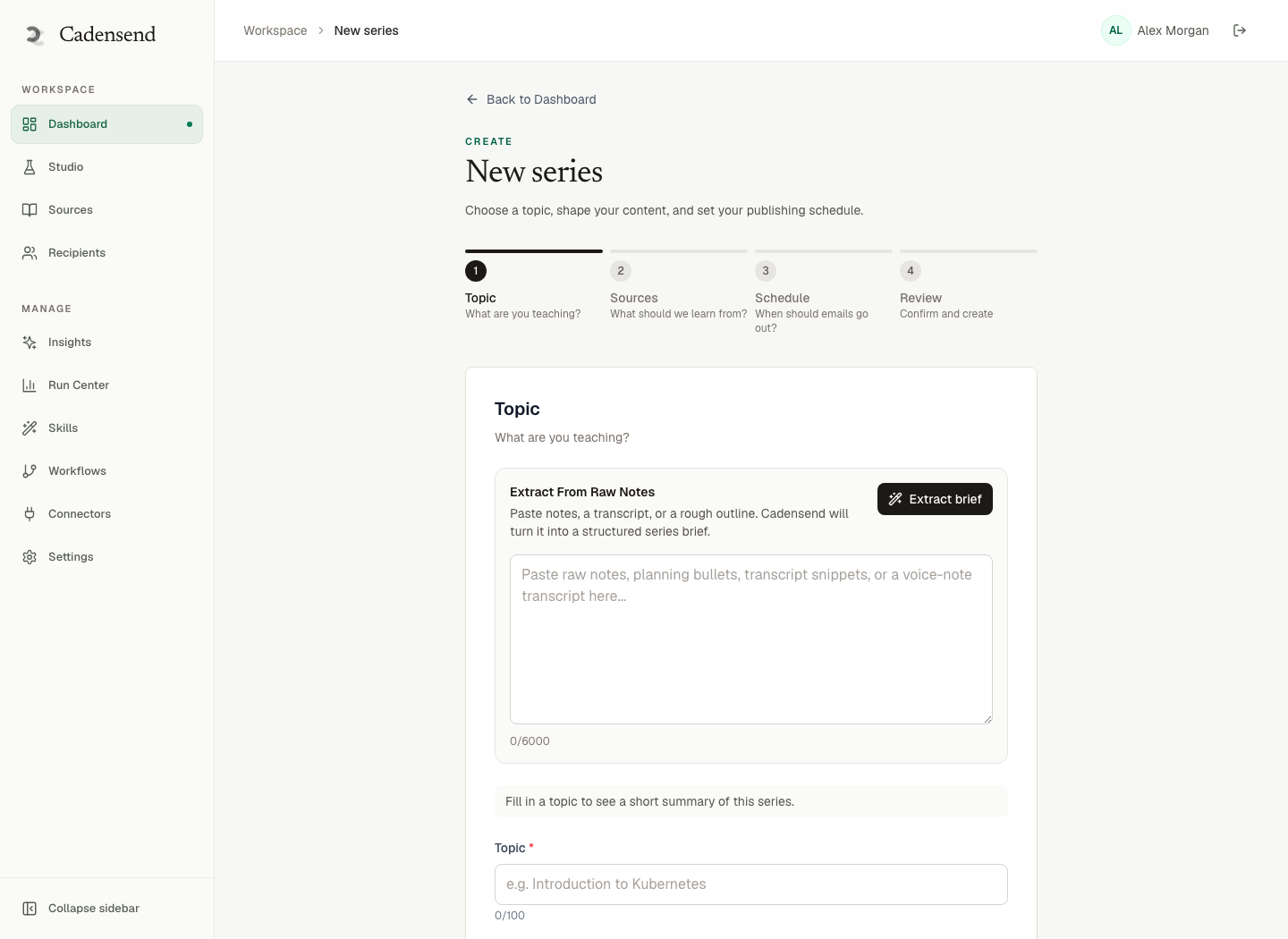
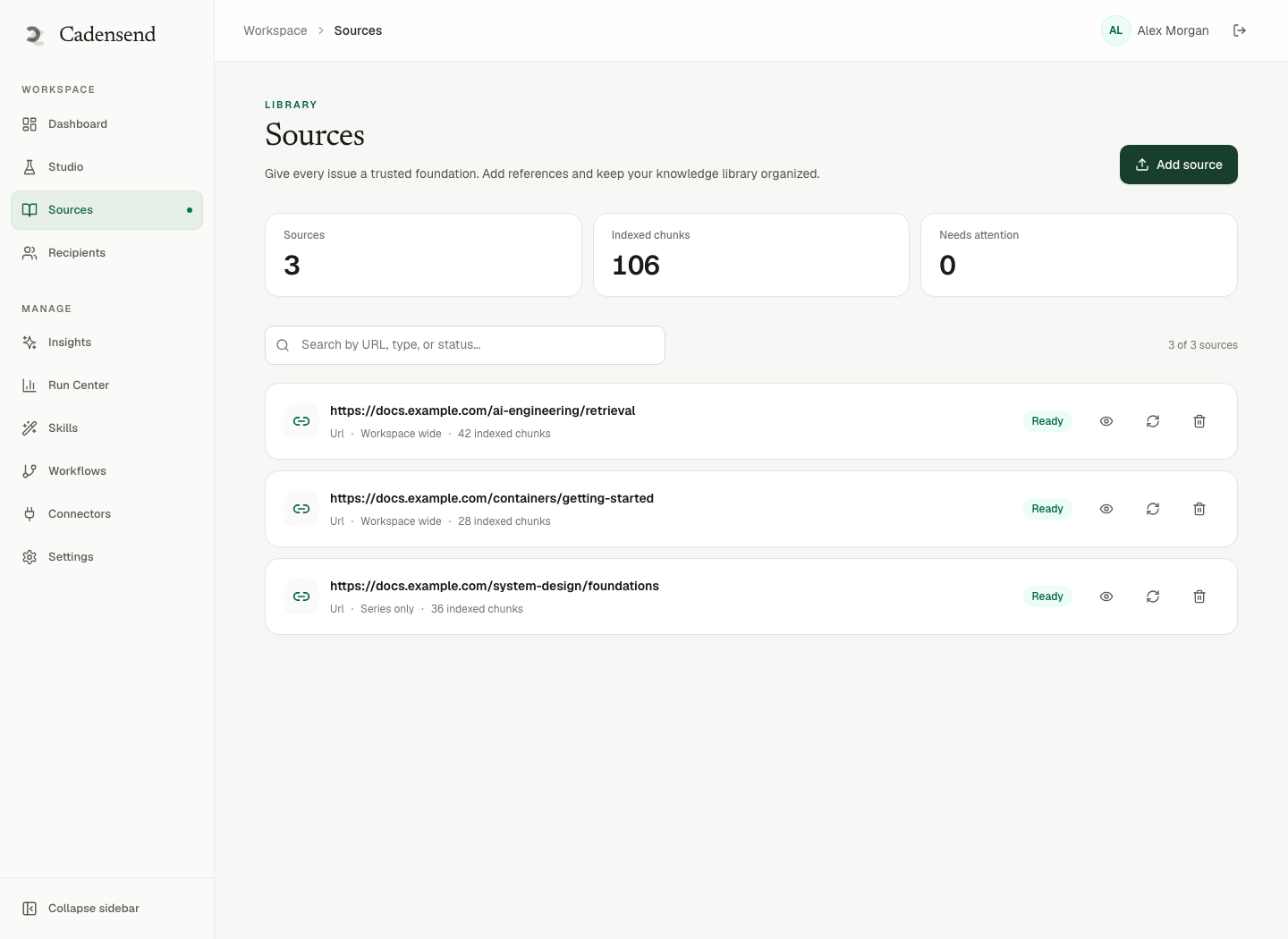
That is Cadensend’s planning idea even if you run it by hand in a chat. If you want the engine to plan, ground, and email the series on a cadence, use Cadensend. Screenshots of series creation and source libraries live on the product page; the constraint is the same: claims trace to sources you supplied.
Store the pack in Notion, Obsidian, or a folder — your second brain — so chats can die. Chats are scratch paper.
Untrusted sources can hide instructions. If you scrape a webpage into the pack, read prompt injection and prefer files you created.
The daily 15-minute loop
Minute 0–1: Open the day’s objective. Close other tabs.
Minutes 1–8: Read the cited section (not a new web search). If using AI, allow one explanation pass: “Explain this section in simpler language. Do not add facts.”
Minutes 8–12: Retrieval. Hide the notes. Answer the quiz in writing. Voice is allowed — capture it with the same habit as voice notes to action items, then file the answer.
Minutes 12–15: Grade yourself against the source. Ask:
Compare my answers to these quotes. Mark correct / incomplete / wrong. Do not soften wrong answers. Give the quote I missed.
If the model “helps” by inventing a third option that is not in the source, you have a hallucination. Treat it like a bad tutor. See LLM hallucination causes and fixes and stop AI making up facts in reports — learning notes are reports to your future self.
Once a week (still 15 minutes): a tiny project, not a quiz. SQL: one query. Writing: one paragraph. Management: one agenda sent.
Prompts that keep the tutor honest
Allowed:
- “Quiz me from these notes. 4 questions. Answers on a second message after I reply.”
- “Make a cloze deletion (fill-in-blank) from this paragraph.”
- “I will paste a mistake I made. Show the source line that contradicts me.”
Forbidden:
- “What else should I know?”
- “Give me shortcuts experts use” (unsourced)
- “Update this with the latest best practices” without a URL you trust
Model choice is secondary. ChatGPT vs Claude vs Gemini can host the quiz. The source pack is the product.
Email series vs chat vs Custom GPTs
Chat is pull. You must remember to pull. Email is push. Calendars already won this fight.
| Format | Strength | Failure mode | Use when |
|---|---|---|---|
| Daily chat | Fast clarification | You skip days; context drifts | You already have a streak |
| Custom GPT / Project | Files in one place | Invents when files are silent; cloud retention | Vendor workspace is approved |
| Spaced email series | Shows up; one issue at a time | Setup cost | You want a finish line |
| Human course | Accountability | Expensive; generic | Credential or cohort matters |
Cadensend sits in the email-series row: self-hosted, MIT, no hosted signup, grounded issues, exactly-once delivery. Compare the whole category in Custom GPTs vs Projects vs email courses.
Small-business owners teaching a process to new hires should not rely on “we have a GPT.” An emailed, cited sequence is kinder to people who are busy. See AI for small business owners.
What AI must not teach you unsupervised
Do not use a general chatbot as:
- Your only source for medical dosing
- Legal advice for a contract you will sign
- Production security configuration you will ship
- Tax filing strategy
Use it to navigate official docs you pasted. For personal PDFs, follow privacy-safe AI for personal documents and PII scrubbing. Your immigration packet is not a study set for a public model.
Cost stays low if you paste the chapter, not the internet. Reducing LLM costs is mostly “stop pasting 80 pages for a 3-question quiz.”
If you later productize an internal tutor for staff, that is AI agent development with evaluation — quizzes with known answers — not an unsupervised “helpful” bot.
A four-week example plan
Skill: “Read a company P&L well enough to ask one smart question in a meeting.”
Sources: one internal finance FAQ (redacted), one public textbook chapter on income statements, last quarter’s already shared board snapshot if you are allowed to have it.
Week 1: vocabulary (revenue, COGS, gross profit). Daily cloze quizzes.
Week 2: margins. Compute three numbers by hand from the snapshot. AI only checks arithmetic against your figures.
Week 3: what changes a margin (price, mix, cost). Questions must cite the chapter.
Week 4: you write a 150-word brief for a fictional meeting. Manager or peer reviews. AI lists unsupported claims.
Fifteen minutes × 20 weekdays = 5 hours. That is enough for one demonstrable skill. It is not an MBA.
Career switchers can swap P&L for interview stories, SQL, or a tool the posting requires — still one month, still sources.
When the streak dies
Most people do not fail at minute 8 of the quiz. They fail at opening the calendar invite.
If you skipped three days: do not stack issues. Start today’s issue only. Guilt curricula die.
If the quiz is always easy: you are rereading, not retrieving. Hide the notes. Raise difficulty with cloze deletions from the same page.
If the quiz is always impossible: the source is too advanced or the objective is too wide. Split the issue. Cadensend-style planning exists to catch missing prerequisites before you feel stupid.
If you only want a new explanation: that is avoidance. Write a wrong answer first. Then ask for the quote.
If work travel wrecks the slot: move the 15 minutes to the same voice-memo walk you already take. Transcribe later. The loop is the practice, not the desk.
Restarting is part of the skill. Put “restart without backlog” in issue 1 of the series so the rule is waiting in your inbox when you flake.
Frequently Asked Questions
Can I really learn a useful skill in 15 minutes a day?
You can learn a bounded skill to a demonstrable level in a few weeks if you practice retrieval and keep a source pack. You cannot become a senior practitioner in 15 minutes a day without years. Name the demo you will perform on day 28.
Is ChatGPT a good tutor?
It is a good quiz writer and explainer when you paste the chapter. It is a bad source of truth when you ask open questions. Grade it like a clever intern: every new fact needs a citation you already own.
How is this different from watching YouTube at 2x?
Video is still mostly recognition (“this looks familiar”). The loop here forces you to produce an answer with the notes closed. That is the part that transfers to the meeting or the interview.
What if I miss a day?
Skip the backlog. Do today’s issue. Series that demand catch-up die. Cadensend’s “exactly once, on cadence” design is deliberate: one issue, not a guilt pile.
Should I use flashcard apps instead?
Use them for atomic facts (syntax, definitions). Use the 15-minute loop for skills that need a paragraph or a tiny project. Many people need both.
How do I keep employer documents out of public chats?
Redact, use a workspace with training off, or self-host. Read the privacy guide before you upload a runbook that contains customer names.
Can HinterBuild build a custom tutor for our team?
Yes, as a product with evaluation and source control — see AI agent development. For an open-source email curriculum you run yourself, start with Cadensend.
Which model should I quiz myself with?
The cheapest model that follows “only from these notes.” Route hard explanation to a stronger model only when the cheap one fails a known quiz. That is the spirit of reducing LLM costs.
Conclusion
- Shrink the skill to a demo on a date.
- Teach from a pack, not from the model’s memory.
- Spend the last minutes on retrieval, not on another explanation.
- Push the next issue to your inbox if pull-based chat keeps failing.
- Check invented facts the way you would check a report.
Fifteen minutes is a design constraint that creates honesty. If the lesson cannot fit, the goal is still too big.
Want a self-hosted series from your own sources, or a consultation on internal enablement? Contact HinterBuild. Learn about the team. Written by the HinterBuild Engineering Team. Connect with Abdul Sami on LinkedIn.
Free consultation
Book a free consultation call on microlearning with AI
30-minute call with the HinterBuild team. Discuss your project, architecture questions, or next steps — no obligation.
Book a meeting
Keep reading
Related articles
Learn a New Framework in One Week With AI
A one-week plan to learn a new framework with AI: daily builds, cited sources, and a curriculum you host — not a hallucinated tutorial.
Read post
Custom GPTs vs Projects vs Email Courses
Custom GPTs vs Projects vs email courses: when to use a chatbot wrapper, a file pack, or a sourced, self-hosted email curriculum you will actually finish.
Read post
Learn a Programming Language by Email in 30 Days
Learn a programming language by email in 30 days using official docs as sources, a cited curriculum, and sends only to your verified address.
Read post
Daily Email Course: Learn Anything From Sources
Build a daily email course from one learning goal and your own sources. Plan modules, cite claims, and deliver each issue exactly once.
Read post