
Learn a Programming Language by Email in 30 Days
Learn a programming language by email in 30 days using official docs as sources, a cited curriculum, and sends only to your verified address.

Muhammad Abdul Sami
· 12 min read
- Learning
- Programming
- RAG
You can learn a programming language by email in 30 days if the series is a syllabus grounded in official documentation, not a month of invented APIs. HinterBuild's Cadensend is an open-source MIT email curriculum engine: one learning goal plus your sources become a cited series. Self-host it. There is no hosted signup. The MVP delivers only to your verified address. It is not a marketing platform, CRM, or bulk sender.
This post is a 30-day design: daily cadence, timezone-correct sends, prerequisite modules, and retrieval from language docs you actually ingest. The Point is fluency at reading real references, not finishing a gamified streak with hallucinated std:: methods. Clone Cadensend on GitHub. HinterBuild's RAG and LLM systems practice is the same constraint: if the docs were not retrieved, the model may not assert a signature.
Key Takeaways:
- A 30-day programming email course is a curriculum with official docs as the corpus, not a chat log split into 30 files.
- Exclude blog folklore in the series brief so retrieval cannot prefer a 2019 Stack Overflow answer over current docs.
- Daily cadence only works if send time is local and DST-safe; store UTC plus IANA zone.
- Cadensend plans, grounds, writes, and delivers — MVP to your verified inbox, exactly once via a Postgres queue.
- Hallucinated APIs are worse than skipped days; citation gates must fail closed.
- Self-host under MIT. Do not expect list broadcasting or a hosted Cadensend account.
Table of Contents:
- Why Email Beats Another Tutorial Tab
- Design the 30-Day Outcome Before Day 1
- Source the Language, Not the Internet
- Module Map for a 30-Day Series
- Grounded Examples and the Hallucination Tax
- Cadence, Timezone, and Exactly-Once Sends
- A 30-Day Python Track (Worked)
- What This Is Not
- Frequently Asked Questions
Why Email Beats Another Tutorial Tab
Short answer: Email already has a deadline. Browser tabs do not.
Most "learn X in 30 days" pages are blog posts you binge on a Saturday and forget by Wednesday. The spacing effect says distributed practice wins. A daily issue with one objective, one or two cited examples, and a link back to the language reference is closer to a coach than a bookmark.
Email is also hostile to 4,000-word dumps. That constraint is a feature. Cadensend's Plan stage validates coverage and prerequisite order so day 12 cannot assume day 19's generics lecture. If you want the curriculum-graph view, read curriculum design for email modules. If your corpus is a repo README plus /docs, use a technical email course from a GitHub repo.
HinterBuild is a studio that ships production systems. We did not build Cadensend to grow subscriber counts. We built it because ungrounded "teach me Rust" chats invent traits. For the failure taxonomy, see LLM hallucination causes and fixes and avoid AI hallucination in educational content.
Design the 30-Day Outcome Before Day 1
Short answer: Name a performance, not a topic. "Python" is not an outcome. "Read and modify a small HTTP service using the standard library" is.
Cadensend's Create Series wizard captures topic, included and excluded concepts, outcome, audience level, cadence, timezone, and tone. Fill every field. Exclusions matter more than inclusions for programming series: "no third-party web frameworks," "no deprecated Python 2," "no ORM internals."
| Field | Weak | Strong |
|---|---|---|
| Outcome | Get better at Go | Write a CLI that parses flags and hits an HTTP API using only the standard library |
| Audience | Beginner | Engineer fluent in another language, new to Go |
| Include | Everything | Packages, interfaces, error wrapping, tests |
| Exclude | Nothing | Generics deep-dive, cgo, module proxies |
| Cadence | Whenever | Daily, 06:45 local, 30 issues |
The planner should reject a 30-issue outline that never mentions errors if the outcome requires production-shaped code. That validation loop is a LangGraph-style graph with a revision pass, not one-shot bullet points.
Lock approved issues. If you rewrite day 3's objective after seeing day 1, regeneration must not clobber the lock. That identity rule is cousin to idempotency in distributed systems.
A 30-day track is a special case of a personal knowledge email series where the "notes" are language references. It is also a special case of turning documentation into email curriculum.
Source the Language, Not the Internet
Short answer: Ingest the official docs (and maybe one book you own). Do not let the model browse.
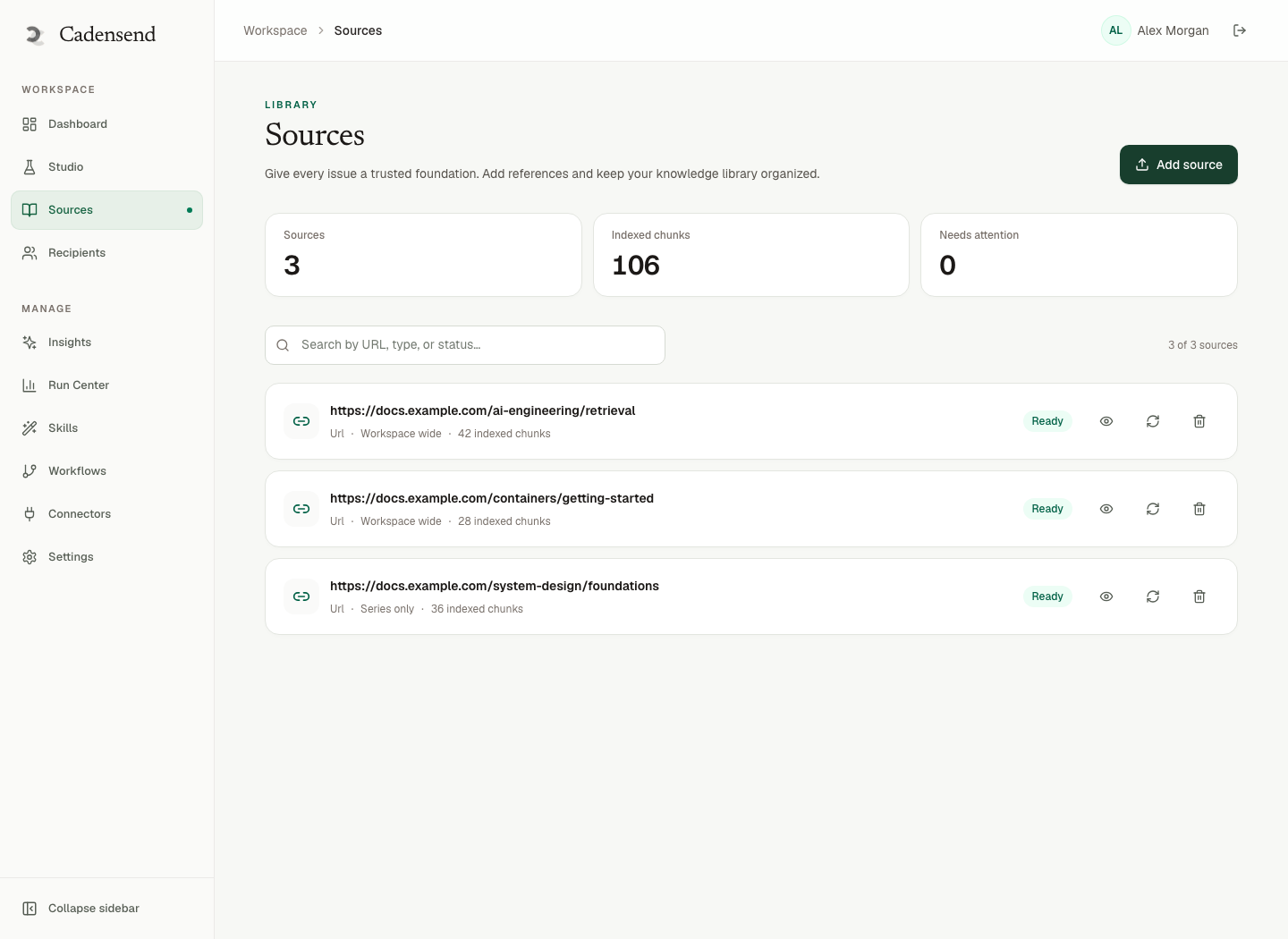
For Python, start from docs.python.org and the library reference. For Rust, the book and std docs. For TypeScript, the handbook. Upload files or point Cadensend at URLs. Structure-aware ingestion keeps heading hierarchy, code fences, and tables, and records section anchors so a citation is a location, not a gesture.
Retrieval is filtered to workspace and series before the vector store. That prevents a second series on Kubernetes from leaking into day 8 of Go. If search still returns the wrong tutorial section, you have a classic RAG garbage problem: chunking, filters, or query mismatch — not "the model is bad."
Embeddings encode chunks, not wisdom. Read embeddings explained before you blame the LLM for missing contextlib. Diversify by source so one giant "What's New" page cannot occupy the whole context window.
Cadensend ingestion is content-hash keyed and resumable. Re-fetching docs after a language release should update changed pages, not duplicate them. HinterBuild RAG engineering uses the same idempotent ingest pattern.
Module Map for a 30-Day Series
Short answer: Four to six modules, issues inside modules, prerequisites explicit.
A workable 30-day map for "second language, already an engineer":
- Days 1–5 — Syntax and toolchain. Install, modules/packages, fmt, run tests. No cleverness.
- Days 6–12 — Data and control. Types, errors/options, collections, iteration.
- Days 13–18 — Structure. Packages, interfaces/traits, visibility, testing tables.
- Days 19–24 — I/O. Files, HTTP client, JSON, timeouts. Cited from std docs only if that was the exclusion set.
- Days 25–28 — Sharp edges. Concurrency or generics or packaging — pick one, because 30 days is short.
- Days 29–30 — Capstone. One small program. The issue should point at docs you already cited, not new APIs.
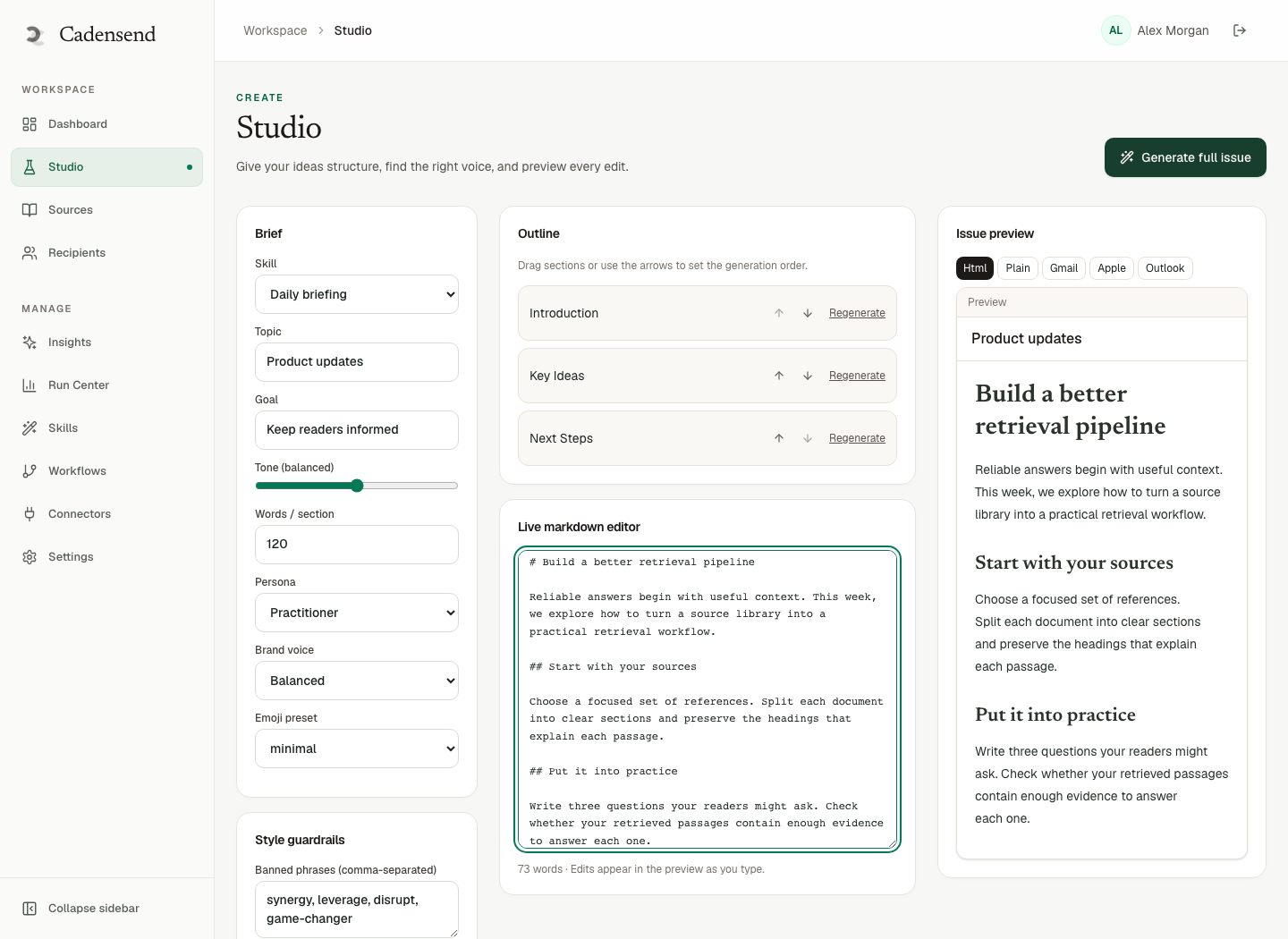
Plan Studio is where you reorder when the graph is wrong — for example, introducing tests before the syntax to run them. Coverage checks should fail if the outcome mentioned HTTP and no issue retrieved the http package docs.
This is curriculum design with a calendar. It is not a drip campaign. For how drip timing interacts with sleep and workdays, see email learning cadence and timezone.
Grounded Examples and the Hallucination Tax
Short answer: Code blocks must come from retrieved docs or from a clearly labeled exercise scaffold. Invented standard-library functions are defects.
Programming series fail in a specific way: the model emits requests.get in a "stdlib only" Python course, or a Go method that existed in a blog post from 2017. Readers trust code more than prose. Grounded AI writing is the same discipline as teaching: claims need chunks; the renderer emits citations; quality gates reject uncited specifics.
Cadensend's write graph: retrieve, write, spec visual (diagrams as data, not pasted screenshots), critique, gate, revise within a hard limit. Output is a block AST, never raw HTML. That stops the model from injecting tracking pixels or broken tags. Diagrams render server-side from specs (Mermaid/D2) with required alt text.
Compare that to a generic newsletter writer. For the distinction, grounded AI writing for newsletters and avoid hallucination in educational content are the companion posts.
When we ship RAG systems for client docs, we measure citation coverage, not vibes. Do the same for your 30-day course: if day 14's HTTP example cannot point at a retrieved heading, regenerate the section, do not "just send it."
Cadence, Timezone, and Exactly-Once Sends
Short answer: Daily local morning, Postgres-backed queue, record before provider, one verified recipient.
Thirty days of duplicates will train you to unsubscribe from yourself. Cadensend claims jobs with Postgres FOR UPDATE SKIP LOCKED, writes the delivery record, then calls the email provider. Keys: workspace, issue, recipient, issue version. Retries replay the original attempt. Details: exactly-once email delivery for courses, skip locked pattern, idempotency. HinterBuild backend API engineering is the same pattern for any side-effecting job.
Timezone: store UTC instant and original IANA zone. A 06:45 America/New_York send should not jump an hour because a deploy used server local time. Cadence design is email learning cadence and timezone.
MVP: verified address only. Not a cohort, not a classroom list, not ConvertKit. Later updates may add opt-in audiences after consent and suppression exist. Until then, you are the student. Self-host from GitHub. No hosted Cadensend signup exists.
A 30-Day Python Track (Worked)
Short answer: Outcome "stdlib HTTP CLI"; sources tutorial + library reference; 30 issues; lock as you go.
Goal: Ship a command-line tool that fetches a JSON URL, handles non-200s, and prints a field, using documentation current to the ingested Python 3 version.
Sources: Tutorial, urllib, json, argparse, unittest or unittest.mock pages — not PyPI marketing.
Week 1 issues cite the tutorial's control flow and data structures. Exercises ask you to type the example, then change one literal. The citation must open the same heading you read.
Week 2 introduces modules and virtual environments only if those pages are in the corpus. If you excluded packaging, the planner must not sneak poetry in.
Week 3 is urllib.request and errors. If the model writes httpx, the gate should fail because that token never appeared in retrieved chunks.
Week 4 is the CLI plus tests. Day 30 is a recap with links to the four headings you struggled with, not new APIs.
This is how documentation becomes email curriculum with a calendar. If you prefer notes and papers over language docs, use the personal knowledge email series workflow.
If you are choosing infrastructure, open source email course platforms compares list tools versus a curriculum engine. Cadensend is the latter.
What This Is Not
Short answer: Not a bootcamp, not a drip promo, not an autonomous coding agent.
Cadensend's writer has no arbitrary network and no code execution. It will not run your tests. It will not open PRs. Retrieved content cannot register tools. That boundary is documented on the Cadensend product and matches how we isolate tools in RAG LLM systems.
It is also not a replacement for writing code. The email is the prompt to open an editor. The citations are the map. Thirty days is enough to build a reading habit against official docs. It is not enough to fake senior-level fluency. Be honest in the outcome field.
Cost: Cadensend is MIT and free. You pay your LLM, your email provider, and your host. Our backend and RAG teams help clients wire similar queues and retrieval, including contact for programming email courses.
Frequently Asked Questions
Can I really learn a programming language by email in 30 days?
You can build a durable reading and practice habit against official docs in 30 days if the series is cited, sequenced, and daily. You will not absorb an entire ecosystem. Set the outcome to one small class of programs.
Does Cadensend send the course to students on a waitlist?
No. MVP delivery is only to your verified address. There is no list sending and no hosted signup. Self-host the MIT repo.
Should I include YouTube transcripts as sources?
Only if you want those claims citable. Transcripts are messy and often wrong about APIs. Prefer official HTML docs. Bad sources are how you get RAG garbage.
How do I stop the model from using the wrong language version?
Ingest the versioned docs you care about, put the version in the series brief, and fail issues that cite APIs absent from retrieved chunks. See hallucination fixes.
Daily email feels like spam. Can I do three issues a week?
Yes. Cadence is a series field. Three weekly issues for ten weeks is often more realistic. The 30-day frame is a pacing device, not a moral law. Read cadence and timezone.
Is this different from GitHub Copilot teaching me?
Copilot completes code in the editor without a syllabus or durable citations into your ingested docs. A 30-day email course is planned, gated, and scheduled. They solve different jobs.
What if I miss a week?
Unread issues should remain scheduled, not burst as six emails on Sunday. Exactly-once delivery still applies; catch-up is a product choice. Do not "resend" by creating a new version unless you intend a new issue identity — see exactly-once delivery.
Who implements this for an internal engineering academy?
Contact HinterBuild. We are the studio behind Cadensend. Related services: RAG and LLM systems, backend API engineering.
Conclusion
Learn a programming language by email in 30 days only if the mail is a cited curriculum: official sources, prerequisite order, local cadence, and sends that cannot double.
- Write an outcome, not a language name.
- Ingest versioned docs; exclude folklore.
- Gate code examples on retrieved chunks.
- Schedule in the learner's IANA timezone.
- Self-host Cadensend; you are the only MVP recipient.
Start from Cadensend and the GitHub repository, or book a consultation on programming email courses. More on HinterBuild.
Connect with Abdul Sami on LinkedIn.
Free consultation
Book a free consultation call on programming email courses
30-minute call with the HinterBuild team. Discuss your project, architecture questions, or next steps — no obligation.
Book a meeting
Related Articles
- Personal Knowledge Email Series From Notes
- Email Learning Cadence and Timezone That Gets Read
- Exactly-Once Email Delivery for Courses
- Turn Documentation Into Email Curriculum
- Open Source Email Course Platforms
- Technical Email Course From a GitHub Repo
- Grounded AI Writing for Newsletters
- Avoid AI Hallucination in Educational Content
- Curriculum Design for Email Modules and Prerequisites
Keep reading
Related articles
Turn Documentation Into Email Curriculum
Turn documentation into an email curriculum with structure-aware ingestion, cited issues, prerequisite checks, and self-hosted delivery to you only.
Read post
Personal Knowledge Email Series From Notes
Turn a personal knowledge email series from notes, PDFs, and bookmarks into a cited, scheduled curriculum you send only to yourself.
Read post
Daily Email Course: Learn Anything From Sources
Build a daily email course from one learning goal and your own sources. Plan modules, cite claims, and deliver each issue exactly once.
Read post
Keep a Course Updated When Sources Change
Maintain source-grounded email courses when docs move: detect staleness, relock issues, and regenerate only the lessons that actually broke.
Read post