
Personal vs Team Learning Series by Email
Choose personal vs team email learning series by audience, review, cadence, and delivery — without turning teaching ops into a bulk newsletter.

Muhammad Abdul Sami
· 10 min read
- Learning
- Teams
- Courses
- Operations
Personal vs team learning series fail when you copy the same curriculum object into a different social setting. A series you send yourself at 7:10am can be opinionated, half-finished, and slightly too hard. A series you send a team has to be true, timed to timezones, reviewable by someone who will get paged, and silent about jokes that do not travel.
Email is a good medium for both. It is a bad medium for pretending they are the same product. This guide is the split we use when designing curricula, including on Cadensend — HinterBuild's MIT-licensed, self-hosted email curriculum engine. Cadensend is not ConvertKit, not a CRM, and not a bulk sender. There is no hosted signup. You clone the GitHub repo and run it.
Key Takeaways:
- Personal series optimize for your retrieval practice. Team series optimize for shared truth and on-call safety.
- Review is optional-but-wise when you are the only learner; review is a gate when someone else will act on the lesson.
- Cadence and timezone are product features for teams and a preference for solo learners.
- Do not “just BCC the team” with a personal series. Consent, context, and version locks differ.
- Measure differently: solo = can you do the task; team = can two people give the same answer.
- Use the same grounding and HITL machinery; change who may approve send.
Table of Contents:
- The actual difference is the risk of being wrong
- Comparison table: personal vs team
- Personal series: design for one brain
- Team series: design for a shared production
- Cadence, timezones, and exactly-once
- Review, roles, and locks
- What Cadensend supports today vs later
- Migration: solo series that grew a team
- Frequently Asked Questions
The actual difference is the risk of being wrong
If you teach yourself system design by email and mix up consistent hashing details, you waste an evening. If you teach the on-call rotation a wrong failover step, you waste an incident.
That is why human-in-the-loop approval gates feel heavy for a personal series and light for a team series. The architecture can be identical. The default autonomy should not be.
Personal series still deserve grounding. LLM hallucinations will happily tutor you in a plausible library that does not exist. You are credulous at 6am. Citations are a gift to future you.
Team series deserve everything personal series deserve, plus:
- A named reviewer who works on the system
- Locks so a prompt tweak cannot rewrite the shared lesson overnight
- A plan that matches how the team actually ships, not a generic blog syllabus
- Delivery that respects local hours so you are not “teaching” at 2am in one region
Internal onboarding email courses are team series with a rotating audience. Founders teaching customers are team series where the “team” includes people who do not share your Slack. Do not use personal-series sloppiness there.
If you need help drawing the boundary in software, HinterBuild's about page is the short story; contact is the work order. The send path is backend API engineering.
Comparison table: personal vs team
| Dimension | Personal series | Team series |
|---|---|---|
| Primary goal | Change your own practice | Align how the group operates |
| Wrongness cost | Private | Operational / reputational |
| Reviewer | You, preferably next day | Domain owner, not the generator |
| Sources | Books, papers, your notes | Runbooks, repo, policy, ADRs |
| Tone | Direct, even blunt | Neutral, reproducible |
| Cadence | Whatever you will open | Workdays, timezone-aware |
| Diagrams | Optional but useful | Required when the path is shared |
| Measurement | Self-quiz, shipped artifact | Shared quiz, observed behavior |
| Send tool | Curriculum engine to you | Curriculum engine + consent story |
| Bulk list? | Never needed | Still not Cadensend's job |
Cadensend's MVP is explicitly “individual learner / creator” with delivery to a verified recipient. That matches personal series today. Team fan-out, opt-in audiences, and analytics are later, gated work. Until then, teams can still author in Cadensend and distribute through whatever consented channel they already have — without turning Cadensend into ConvertKit.
Personal series: design for one brain
A personal series is retrieval practice with a stamp. Spaced practice works; email is a crude scheduler that you will actually obey.
Design rules:
- One outcome. “I can sketch a rate limiter and name two failure modes,” not “learn distributed systems.”
- Exclude aggressively. Cadensend's wizard captures included and excluded concepts. Use exclusions. Your series is not a MOOC.
- Keep issues short. If you will not finish it on a phone on the train, you will archive it.
- Demand an action. Re-draw the diagram from memory. Run the query. Write the failing test.
- Review once. Use the AI lesson review pass. You are allowed to be the reviewer. You are not allowed to skip faithfulness.
Personal series are where diagrams in email pay off: you will remember the picture you struggled to export correctly.
Do not auto-send twelve AI drafts at midnight because the model was “on a roll.” That is how you train yourself on hallucinations. Cadensend holds issues awaiting review for a reason.
Cost: a personal series should be cheap. Cache retrieval, use a small model for drafts, a stronger model for critique. Reducing LLM costs is how the habit survives.
Coding assistants help you pull quotes from a book PDF or a repo. OpenClaw vs Claude Code is a reasonable daily-driver choice. The ChatGPT cheat sheet is for prompts. None of them should be the scheduler.
Team series: design for a shared production
Team series are closer to runbooks than to newsletters.
Write like two new hires will disagree. If the lesson cannot produce the same action from two readers, it is an opinion piece. Label opinions. Put procedures in numbered steps.
Cite the repo, not the vibe. “We use SKIP LOCKED for the mailer” should link the module. Cadensend's structural citations exist for this. Maintenance then follows keep the course updated when sources change.
Pick a reviewer who gets paged. They will hate incorrect timeouts. That hatred is quality control.
Timezone is fairness. Cadensend stores the UTC instant beside the original IANA zone so DST does not silently shift a 9:00 series. Teams split across regions should send local morning, not HQ morning.
Do not mix HR and on-call. A culture-values issue and a failover issue are different series. Mixing them trains people to skim.
Diagrams are shared memory. Follow PNG-in-inbox, spec-in-git. See diagrams in email.
Measure with the same question, two people. If Alice and Bob cannot both name the three hops, the issue failed. Details in measure whether an email course taught.
Team series are not marketing. If someone asks to “add a CTA to book a demo” at the bottom of the retry-lesson, they want ConvertKit. Cadensend will not make that a good idea.
Cadence, timezones, and exactly-once
Personal: three issues a week is a lot. Two is plenty. Pause when you are in production firefighting; a curriculum engine should not guilt you. Cadensend's Run Center shows scheduled vs failed; use pause as a first-class action in your own runbooks even if you implement it as “don't approve the next one.”
Team: announce cadence in issue 0. Missed sends are trust damage. Exactly-once matters more than clever copy. Cadensend writes the delivery record before the provider call; retries return the original attempt. Duplicate teaching emails are how people filter you.
If you build this yourself, read idempotency and SKIP LOCKED. HinterBuild implements that class of worker in backend API engineering.
Do not use a marketing “drip” that resends on open. Teaching is not a funnel. Re-sends should be explicit review or a new version for a new cohort.
Review, roles, and locks
Personal: planner, writer, reviewer, sender can be one human and one engine. Still keep send privileged. HITL courses explain why.
Team: split reviewer from writer. Lock approved issues. Source owners triaged in the weekly ritual from source-change maintenance.
A useful extra role for teams: cohort owner — the person who decides when a new hire starts issue 1. That is not the model.
Approval UIs must show the artifact that will be sent, retrieved chunks, and version. Chat is a bad UI. Same lesson as HITL agents.
What Cadensend supports today vs later
Be honest with stakeholders.
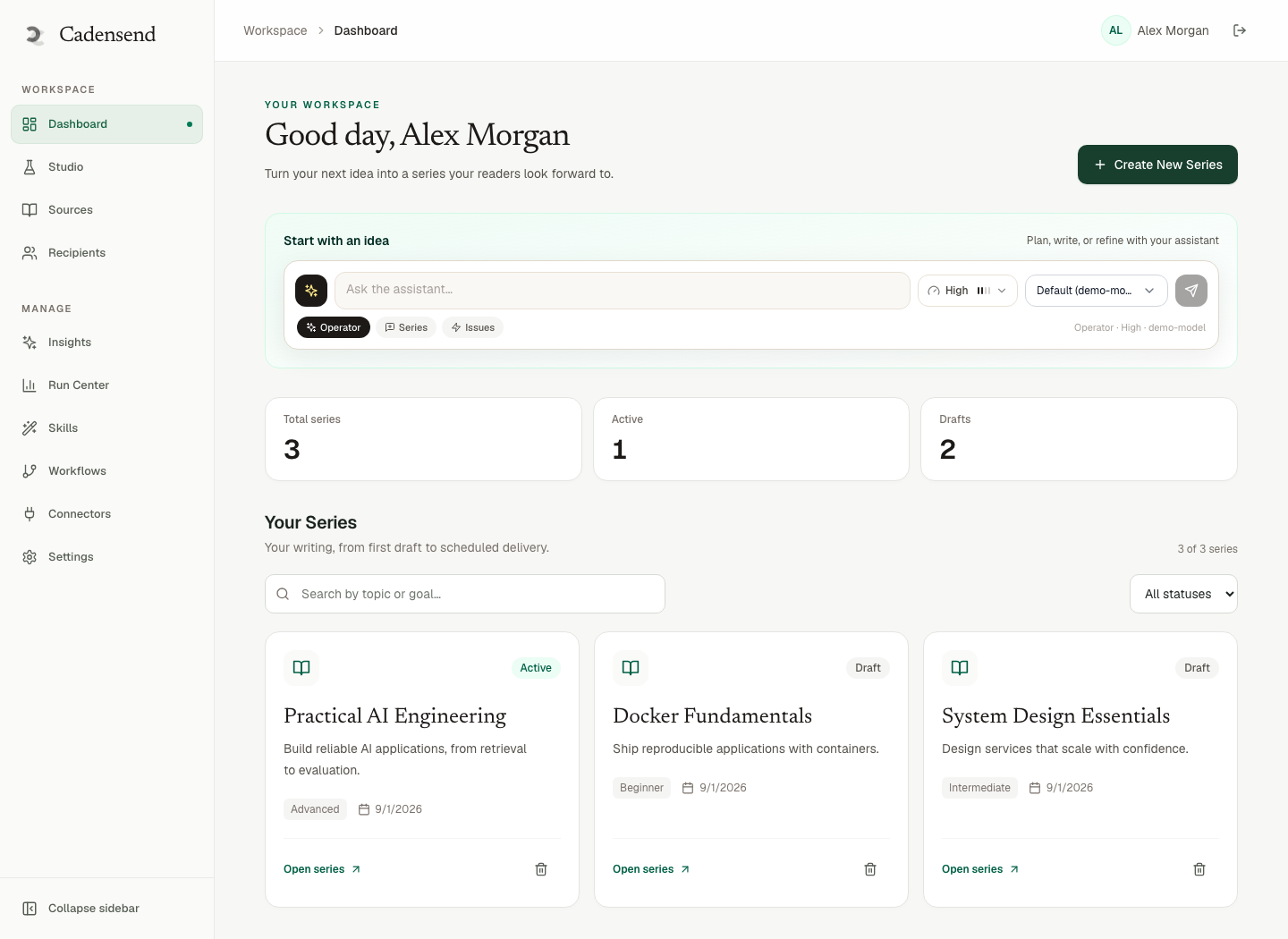
Today (MVP): plan, grounded generation, scheduling, delivery to a single verified recipient. Individual learner / creator. Self-hosted. MIT. No hosted signup.
Later (roadmap on the product page): hybrid retrieval, citation scoring, opt-in audiences, consent, unsubscribe, analytics, quizzes, branching, roles, SSO, SCIM.
If a VP asks “can we drop this on 4,000 employees next week,” the answer is no — not because email teaching is wrong, but because consent, suppression, and tenancy are real work. Cadensend refuses to pretend it is a bulk sender.
Teams can still win today: author the series in Cadensend, review in Content Studio, send to the verified trainer address, and the trainer forwards through the company's existing, consented channel. Awkward. Honest. Better than an unsupervised agent with SMTP.
Migration: solo series that grew a team
This happens constantly. You wrote yourself a Postgres series. Three teammates want it.
- Re-ground. Replace “my notes” with the team's runbooks.
- Re-review every issue with a domain owner. Your jokes and your cluster names may not apply.
- Re-diagram anything that showed your laptop setup.
- Lock after that pass.
- Change measurement from self-quiz to shared quiz.
- Do not BCC. Use a channel with an owner and an unsubscribe story if it leaves the company.
If the series is now customer-facing, read founders teach customers before you send issue 1.
If it is now onboarding, read internal onboarding email courses.
Use ChatGPT to list candidate exclusions when converting personal → team (“remove my home-lab IPv6 tangent”). Then delete them yourself.
Frequently Asked Questions
Should I write a personal learning series or a team one?
If only your behavior must change, write a personal series. If two people must take the same production action, write a team series with a domain reviewer and locks.
Can I send my personal series to the whole company?
Not without re-grounding, re-review, and a consented channel. Personal series contain assumptions that are expensive when they become policy.
Is Cadensend for teams or individuals?
The MVP is an individual learner/creator sending to a verified recipient. The architecture (plan, ground, write, review, exactly-once) is how you later grow into teams. It is not a bulk newsletter platform.
How do timezones work for a distributed team?
Store local intent with an IANA zone and a UTC instant. Do not store “9:00” without a zone. Cadensend preserves local intent across DST.
Do team series need diagrams in every issue?
No. They need diagrams when the shared object is a path, topology, or sequence. When you include one, use PNG in the inbox and a spec in git.
How should I measure each type?
Personal: a task you can perform without the email open. Team: two people independently produce the same answer or action. See measurement.
Can coding assistants generate the team series unsupervised?
They can draft. They must not approve or send. Compare tools in OpenClaw vs Claude Code; keep SMTP out of the assistant.
Conclusion
- Personal series are retrieval practice; team series are shared operational truth.
- Same engine, different gates. Review and locks scale with the cost of being wrong.
- Cadence and timezone are fairness for teams, preference for solo learners.
- Exactly-once delivery beats clever drips. Duplicates train filters, not people.
- Cadensend is MIT, self-hosted teaching ops — not ConvertKit, not a bulk sender.
Building personal or team curricula on your own sources? Contact HinterBuild. About and LinkedIn if you want the humans first.
Free consultation
Book a free consultation call on personal vs team email learning
30-minute call with the HinterBuild team. Discuss your project, architecture questions, or next steps — no obligation.
Book a meeting
Keep reading
Related articles
Personal Knowledge Email Series From Notes
Turn a personal knowledge email series from notes, PDFs, and bookmarks into a cited, scheduled curriculum you send only to yourself.
Read post
Measure Whether an Email Course Actually Taught
Measure email course learning with tasks, quizzes, and cohort diffs — not open rate. Pair evidence with HITL review and source-grounded issues.
Read post
Founders Teach Customers With Email Curricula
How founders teach customers with email curricula: source-grounded lessons, review gates, and a self-hosted engine that is not a bulk blaster.
Read post
Email Learning Cadence and Timezone That Gets Read
Set an email learning cadence and timezone that gets read: local send instants, DST-safe IANA zones, and a Postgres queue that never double-sends.
Read post