
Personal Knowledge Email Series From Notes
Turn a personal knowledge email series from notes, PDFs, and bookmarks into a cited, scheduled curriculum you send only to yourself.

Muhammad Abdul Sami
· 12 min read
- Learning
- RAG
- Knowledge Management
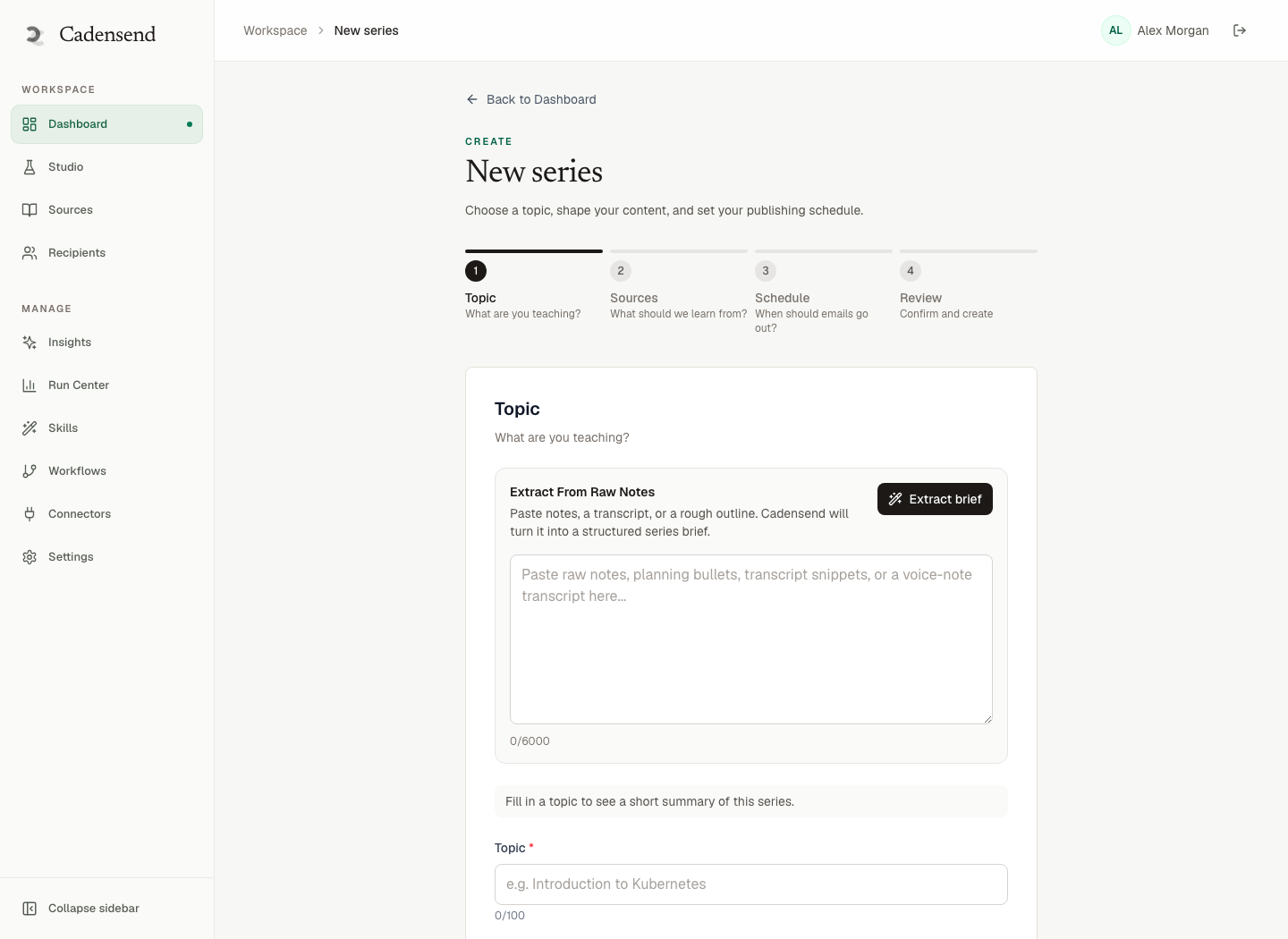
A personal knowledge email series is not a newsletter list. It is a curriculum generated from your notes, papers, and bookmarks, then delivered as sequenced issues you actually finish. Most second brains stall at capture. The unread pile in Obsidian, Notion, or a ~/notes folder grows faster than recall. Cadensend, HinterBuild's open-source email curriculum engine, turns one learning goal plus those sources into a cited series you self-host. There is no hosted signup. The MVP sends only to your verified address.
This guide shows how to convert a personal knowledge base into an email series with real citations, prerequisite order, and exactly-once delivery. It is for builders who already write notes and want retrieval that teaches, not a dump of embeddings. For the product architecture, clone Cadensend on GitHub (MIT). HinterBuild's RAG and LLM systems work is the same family of problems: retrieve the right chunk, refuse to invent the rest.
Key Takeaways:
- A personal knowledge email series succeeds when every claim cites a note, PDF, or URL you supplied — not model memory.
- Capture tools store; curriculum engines sequence. You need both Plan and Ground, not another inbox.
- Structure-aware chunking beats naive splitting: keep headings, code, and tables so citations land on real anchors.
- Cadensend is self-hosted, MIT licensed, and not a CRM, marketing suite, or bulk sender.
- MVP delivery is to your verified address only; opt-in audiences are a later, consent-gated update.
- Exactly-once sends use a Postgres queue, not an in-memory cron that forgets on deploy.
Table of Contents:
- Why Notes Do Not Teach You
- What a Personal Knowledge Email Series Actually Is
- Plan, Ground, Write, Deliver
- Ingesting Notes Without Destroying Structure
- Citation Rules That Stop Invented Sources
- Scheduling Issues You Will Open
- A Worked Example From a Research Vault
- Failure Modes We See in PKM-to-Email Pipelines
- Frequently Asked Questions
Why Notes Do Not Teach You
Short answer: Capture systems optimize for storage. Learning requires spaced retrieval, prerequisite order, and a deadline that is not "someday."
Zettelkasten and evergreen notes are excellent at linking. They are weak at pacing. You highlight a paper, tag #to-read, and never reopen it. The spacing effect is well replicated: distributed practice beats massed rereading. Email is a terrible CRM surface and a surprisingly good personal tutor surface because it already has a cadence, a timezone, and a read-or-archive decision.
A personal knowledge email series exploits that decision. Each issue has one objective, a bounded source set, and citations you can click back to the original heading. That is closer to a syllabus than to a digest. If you want a blast to thousands of subscribers, this is the wrong tool — Cadensend's product page is explicit: not marketing, not CRM, not bulk email.
When retrieval quality is poor, the series becomes a confident paraphrase of the wrong paragraph. That is the same failure as a RAG pipeline that returns garbage. Fix chunking and filters before you generate issue three.
What a Personal Knowledge Email Series Actually Is
Short answer: One learning goal, your sources, a validated module/issue plan, grounded drafts, and scheduled delivery to you.
| Approach | Input | Output | Typical failure |
|---|---|---|---|
| Newsletter AI | A vibe and a topic | Uncited prose | Hallucinated facts and fake papers |
| Flashcard export | Isolated facts | Cards | No narrative, no "why this order" |
| Read-it-later digest | URLs | Summaries | No prerequisites, no citations |
| Personal knowledge email series | Goal + your corpus | Sequenced, cited issues | Weak ingestion if you skip structure |
Cadensend's contract is narrow: topic, outcome, audience, includes/excludes, cadence, timezone, tone. A planning graph emits modules and issues, checks coverage and prerequisites, then you lock in Plan Studio before bodies exist. That is curriculum design, not autocomplete. If the source of truth is a repo, use a GitHub-repo email course instead of flattening Markdown by hand.
HinterBuild is a product engineering studio. We built Cadensend because uncited RAG answers kept shipping. Avoid educational hallucination is architecture, not hope.
Plan, Ground, Write, Deliver
Short answer: Four stages, four failure domains. Skip one and the series either ramble, invent, or double-send.
Plan
Planning is a LangGraph-style graph: coverage checks and a revision pass, modules and issues before any HTML. Locking is idempotency: approved artifacts keep their identity.
Ground
Grounding is retrieval over your uploads and URLs. Workspace and series filters apply before the vector store. Chunks are diversified by source so one verbose README cannot dominate every issue. The writer never gets a blank "search the web" tool. Retrieved text is data, never instruction — the same prompt-injection boundary we use in RAG and LLM systems work.
Embeddings are not magic. If you treat cosine similarity as understanding, read the complete embeddings guide and then look at your chunk sizes. Notes with YAML frontmatter, wikilinks, and nested bullets need structure-aware parsing or the embedding of "see [[OtherNote]]" is noise.
Write
The write stage is a bounded agent: retrieve, write, spec visuals, critique, gate, revise. Output is a block AST plus a deterministic renderer — not raw HTML. Citations are ids the renderer turns into links. See grounded AI writing and LLM hallucination causes and fixes.
Deliver
Jobs are claimed from Postgres with FOR UPDATE SKIP LOCKED. The delivery record is written before the provider call. Retrying returns the original attempt. Keys include workspace, issue, recipient, and issue version. This is exactly-once email delivery for courses, implemented as a durable queue, not a sidecar cron. HinterBuild's backend API engineering practice is the same: side effects get identities before they hit the network.
Ingesting Notes Without Destroying Structure
Short answer: Preserve heading hierarchy, code fences, and tables. Record section anchors. Hash content so re-ingest is idempotent.
Personal knowledge bases are messy on purpose. Obsidian wikilinks, Notion export ZIP files, PDF highlights, and a folder of *.md files from 2019 all coexist. Naive chunking by character count splits a proof in half and embeds the second half as if it were a new claim.
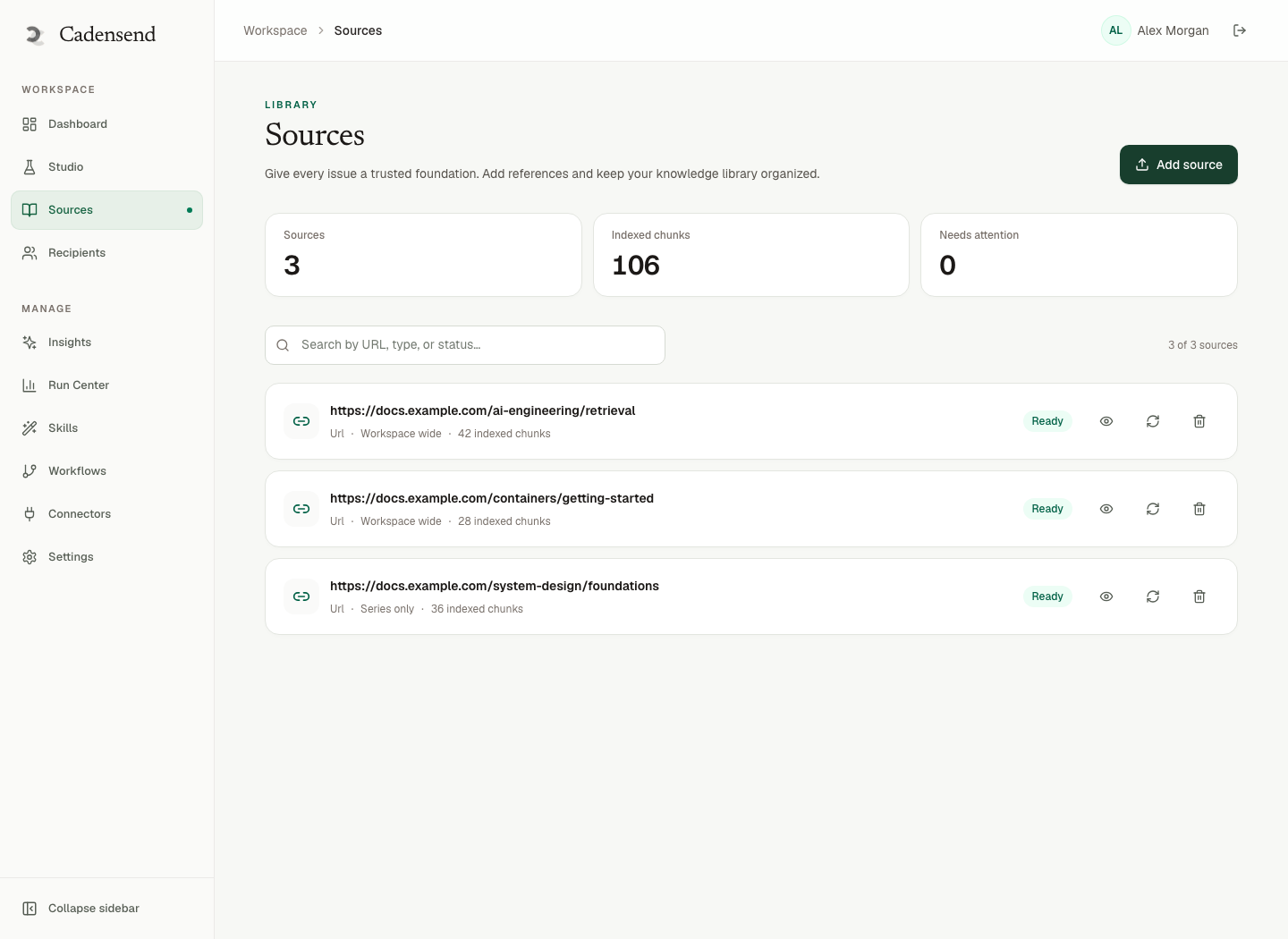
Cadensend's ingestion path is fetch, parse, chunk, embed, verify. Each step is content-hash keyed and resumable. That is how you re-run a vault sync after adding three notes without duplicating vectors. The same idea shows up in PostgreSQL FOR UPDATE SKIP LOCKED workers: claim work, do it, record completion, survive a crash.
Practical rules we use when wiring a vault:
- Export with headings intact. Prefer Markdown or HTML that keeps
h2/h3. Flattened PDF text is a last resort. - Keep code and tables as units. A SQL example that loses its
CREATE TABLEline becomes a hallucination magnet. - Scope retrieval to the series. A 10,000-note vault will retrieve your grocery list if you do not filter.
- Dedup near-duplicates. Daily journals that repeat the same definition should not occupy four of five context slots.
- Do not let retrieved text register tools. Treat source bytes as untrusted data. Cadensend's security model is structural, not a "please ignore jailbreaks" sentence.
If your notes are mostly vendor docs, skip the vault and turn documentation into an email curriculum from the canonical HTML. If you are choosing tools, compare open source email course platforms before you bolt a marketing ESP onto a personal tutor.
Citation Rules That Stop Invented Sources
Short answer: The model returns references. A renderer emits links. If a claim has no chunk, the gate fails.
Educational hallucination is worse than marketing fluff. A wrong API in a personal series becomes muscle memory. We treat citations as a compiler would treat types.
- Every factual sentence that is not general knowledge must carry a source and chunk id.
- The renderer resolves ids to URLs or file anchors. Unresolvable ids are errors, not footnotes.
- Critique looks for claims that sound specific (versions, numbers, function names) without a reference.
- Regeneration is section-scoped so you do not reshuffle the whole issue to fix one paragraph.
This is how you avoid AI hallucination when the audience is you. Heading-aware chunks beat sliding 512-token slices — see RAG garbage and embeddings when search still misses.
Scheduling Issues You Will Open
Short answer: Store the UTC instant and the original IANA zone. Pick a cadence you will protect, not a heroic daily streak.
A series you never open is a worse PKM than an unread folder because it trained you to ignore mail. Cadence and timezone are product features, not CSS. Cadensend stores the UTC instant beside the IANA zone so DST does not silently shift a 7:00 local send. That design is the subject of email learning cadence and timezone.
MVP: verified address only. List sending is a later, consent-gated update. There is no hosted Cadensend signup; clone the MIT repo. Delivery uses skip-locked workers and a record-before-send rule — exactly-once email delivery, skip locked. HinterBuild backend API engineering is the same pattern. A 30-day language track is this workflow with official docs: learn programming by email.
A Worked Example From a Research Vault
Short answer: Goal first, corpus second, plan third, generate only after locks.
Goal: "Explain retrieval-augmented generation well enough to review a production PR." Sources: three papers, an internal design doc, twelve notes. Exclude pitch decks.
The plan should cover retrieval, chunking, citations, and operations, in that order. If evaluation never appears, coverage fails. Lock issue 1 after you edit it.
Issue 2 retrieves the design-doc section on table splits. Critique must fail a "Vaswani et al." sentence if that PDF is not in the corpus — add the file or delete the claim.
Send at 07:15 Asia/Karachi as a UTC instant plus IANA zone. Clicking a citation should land on the vault heading you meant. For handbook-first loops, use docs-to-email curriculum and add personal notes as extra sources — still not a blast list.
Failure Modes We See in PKM-to-Email Pipelines
Short answer: Unscoped retrieval, uncited specifics, unlocked plans, and in-memory schedulers.
| Failure | Symptom | Fix |
|---|---|---|
| Vault-wide retrieval | Grocery lists in a RAG lesson | Series-scoped filters before vectors |
| Character chunking | Citations point at mid-sentence | Structure-aware parse and anchors |
| Model-authored footnotes | Links that 404 | Deterministic citation renderer |
| Plan drift | Issue 5 rewrites after you edited it | Lock approved issues |
| Double send after deploy | Two copies of issue 3 | Postgres queue + pre-provider record |
| "Just email my list" | Compliance and consent holes | Out of MVP scope; do not fake it |
LLM hallucination here is usually a confident API from training data that your notes already contradicted. Cadensend's writer cannot browse or run code; ingested text cannot add tools. Compare list-oriented open source email course platforms if you actually needed an ESP — Cadensend is a syllabus engine.
Frequently Asked Questions
What is a personal knowledge email series?
A personal knowledge email series is a sequenced set of email issues generated from your own notes and files, ordered as a curriculum, with citations back to those sources. It is for learning, not list growth. Cadensend implements that loop as a self-hosted MIT project with no hosted signup.
Can Cadensend send the series to my whole team today?
No. The MVP sends only to your verified address. Opt-in audiences, consent, suppression, and unsubscribe are planned for a later update and are gated on those controls being real. Do not treat Cadensend as a bulk sender.
How is this different from summarizing my Obsidian vault with ChatGPT?
ChatGPT summaries are uncited, unordered, and not scheduled. A personal knowledge email series plans modules, retrieves scoped chunks, gates quality, and delivers exactly once from a durable queue. The difference is architecture, documented on the Cadensend product page.
Do I need a vector database to start?
You need embeddings and a store Cadensend can query with workspace and series filters. The important part is scoped retrieval and content-hash idempotent ingestion, not a brand name. See embeddings explained for the retrieval math.
What if my notes contradict each other?
The planner and writer should surface conflict, not average it. Prefer citing both chunks and stating the disagreement. Silent reconciliation is a hallucination by omission — the same class of bug as RAG garbage.
Is Cadensend a CRM or marketing automation tool?
No. It is not a marketing suite, CRM, autonomous research agent, or bulk-email provider. It turns one learning goal into a structured email series and delivers approved issues reliably and only once.
How do I run it?
Clone github.com/HinterBuild/cadensend, self-host, and plug in your LLM provider, email provider, and infrastructure. Cadensend itself is free under MIT. There is no hosted product to sign up for.
Who should I talk to about wiring this into an existing knowledge system?
Contact HinterBuild about personal knowledge to email series, or read about the studio. Related engineering surfaces are RAG and LLM systems and backend API engineering.
Conclusion
A second brain that only captures is a landfill with tags. A personal knowledge email series forces a goal, a source set, a prerequisite graph, citations, and a send time you will honor.
- Start from one outcome, not from "email everything in the vault."
- Ingest with structure and hashes; retrieve with series scope.
- Write into a validated tree; render citations deterministically.
- Deliver from Postgres with skip-locked workers and a record-before-send rule.
- Stay inside MVP: you, a verified address, self-hosted, MIT.
Self-host Cadensend from GitHub, or schedule a consultation on turning personal knowledge into an email series. HinterBuild's about page is the studio context; RAG systems and backend APIs are how we ship the same primitives for clients.
Connect with Abdul Sami on LinkedIn.
Free consultation
Book a free consultation call on personal knowledge to email series
30-minute call with the HinterBuild team. Discuss your project, architecture questions, or next steps — no obligation.
Book a meeting
Related Articles
- Learn a Programming Language by Email in 30 Days
- Email Learning Cadence and Timezone That Gets Read
- Exactly-Once Email Delivery for Courses
- Turn Documentation Into Email Curriculum
- Open Source Email Course Platforms
- Technical Email Course From a GitHub Repo
- Grounded AI Writing for Newsletters
- Avoid AI Hallucination in Educational Content
- Curriculum Design for Email Modules and Prerequisites
Keep reading
Related articles
Personal vs Team Learning Series by Email
Choose personal vs team email learning series by audience, review, cadence, and delivery — without turning teaching ops into a bulk newsletter.
Read post
Turn Documentation Into Email Curriculum
Turn documentation into an email curriculum with structure-aware ingestion, cited issues, prerequisite checks, and self-hosted delivery to you only.
Read post
Learn a Programming Language by Email in 30 Days
Learn a programming language by email in 30 days using official docs as sources, a cited curriculum, and sends only to your verified address.
Read post
Keep a Course Updated When Sources Change
Maintain source-grounded email courses when docs move: detect staleness, relock issues, and regenerate only the lessons that actually broke.
Read post