
Open Source Email Course Platforms Compared
Compare open source email course platforms vs Cadensend: MIT curriculum engine, self-hosted, cited lessons, no hosted signup, not a bulk ESP.

Muhammad Abdul Sami
· 13 min read
- Learning
- Open Source
- Architecture
Open source email course platforms usually mean "mailers that can drip." HinterBuild's Cadensend is a different artifact: an MIT-licensed email curriculum engine. It turns a learning goal and your sources into a cited series, then delivers approved issues exactly once. Self-hosted. No hosted signup. MVP sends only to your verified address. Not a marketing suite, CRM, or bulk sender.
This comparison is for engineers choosing infrastructure. If you need campaigns, consent, templates, and lists, use a mailer. If you need Plan, Ground, Write, Deliver over a corpus, Cadensend is in a smaller set. Clone github.com/HinterBuild/cadensend. HinterBuild's about page is the studio; RAG and backend APIs are how we ship the same primitives for clients.
Key Takeaways:
- Most OSS "course email" stacks are ESPs with delays. Cadensend is a syllabus compiler plus a durable send queue.
- MIT license on Cadensend does not include a hosted product — you run it.
- MVP delivery is your verified inbox, not a classroom list.
- Grounding and citation rendering are the differentiator, not WYSIWYG templates.
- Exactly-once send uses Postgres skip-locked jobs, not crontab folklore.
- Pick tools by job: lists vs learning. Do not force one database to do both badly.
Table of Contents:
- What People Mean by Email Course Platforms
- Comparison Table
- Listmonk, Ghost, and Campaign Mailers
- LMS and CourseLit-Class Tools
- Where Cadensend Fits
- Grounding, Hallucination, and Why ESPs Do Not Care
- Delivery Reliability Across Tools
- How to Choose Without Lying to Yourself
- Licensing, Deliverability, and What You Actually Operate
- Frequently Asked Questions
What People Mean by Email Course Platforms
Short answer: Three jobs share a name: drip marketing, cohort LMS, and personal curricula.
Search "open source email course" and you get Listmonk tutorials, Ghost members, WordPress plugins, and the occasional LMS that happens to email. Those products optimize audiences. A personal knowledge email series (from notes) or a docs-to-email curriculum optimizes sequence and sources.
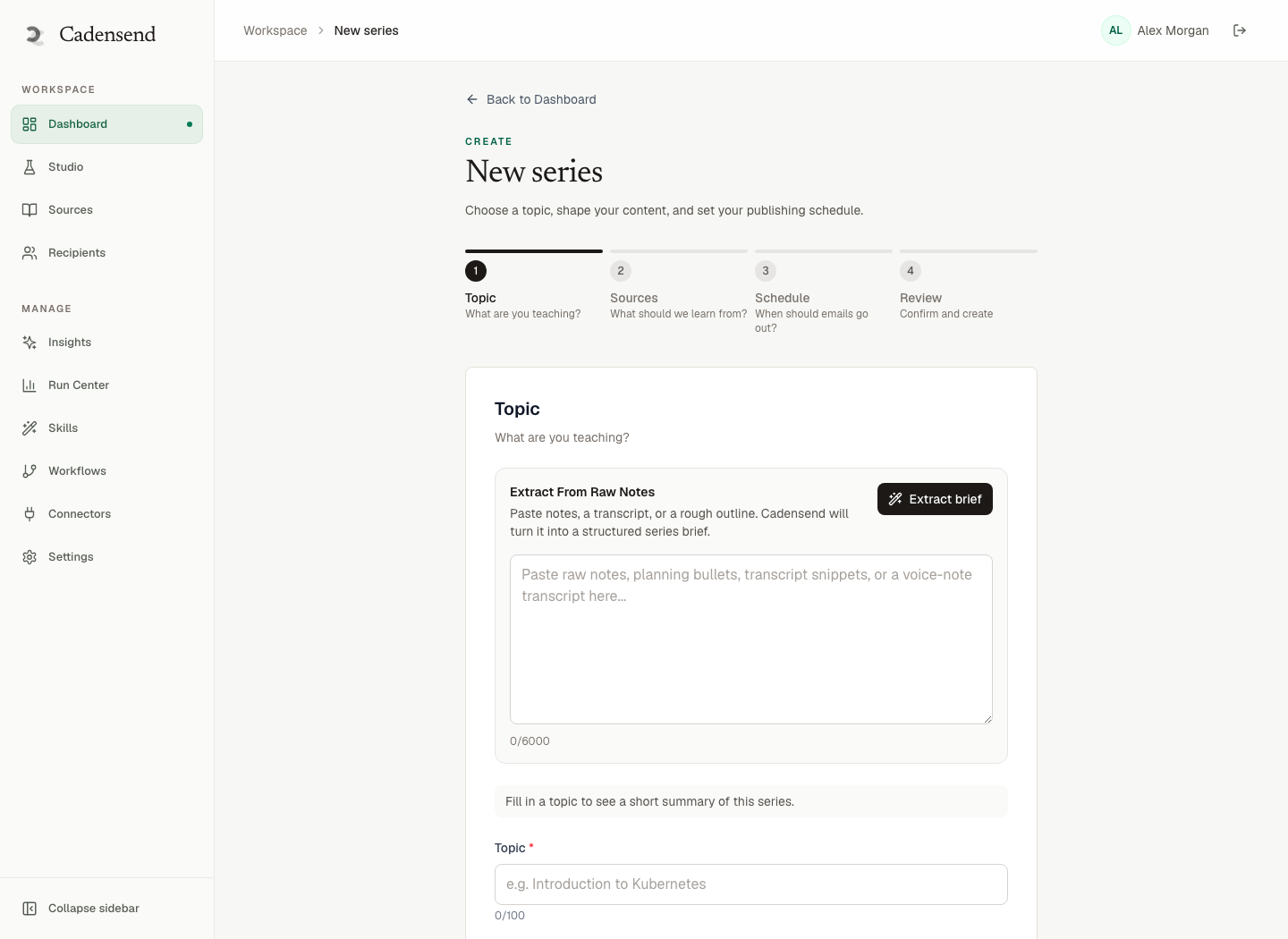
Cadensend's positioning is explicit on the product page: narrow on purpose. Not autonomous research. Not bulk email. The MIT license covers the code you clone. It does not create a Cadensend cloud.
If your actual job is "welcome sequence for signups," stop reading and use a mailer with consent. If your job is "teach me this repo in 18 issues I will finish," keep going.
Comparison Table
Short answer: Match columns to the job, not to GitHub stars.
| Tool | License / model | Strength | Weak for curricula | Sends lists? |
|---|---|---|---|---|
| Cadensend | MIT, self-hosted | Plan/Ground/Write/Deliver, citations, skip-locked queue | Not an ESP; MVP is you only | No (MVP) |
| Listmonk | AGPL, self-hosted | Campaigns, lists, templates, performance | No source-grounded syllabus compiler | Yes |
| Ghost | MIT (software) | Publishing, members, newsletters | Not RAG planning; different product | Yes (members) |
| Mailtrain / similar | OSS mailers | Self-hosted campaigns | No curriculum validation | Yes |
| CourseLit-class LMS | OSS LMS | Lessons, payments, classrooms | Email is a notification channel | Often |
| Hosted ESPs | Proprietary | Consent, deliverability, analytics | Closed, not a grounding engine | Yes |
Stars are not architecture. Listmonk is excellent at what it is. Cadensend should not grow a competitor list module before consent exists.
Listmonk, Ghost, and Campaign Mailers
Short answer: Use them to talk to people who opted in. Do not ask them to retrieve your ADRs.
Listmonk is a high-performance self-hosted newsletter and mailing list manager. You import subscribers, segment, and campaign. That is the opposite of Cadensend MVP. If you put an LLM in front of Listmonk to "write a course," you get uncited drip copy unless you build Ground yourself — at which point you are reinventing Cadensend's write graph poorly.
Ghost is a publisher CMS with newsletters. Great for essays. Weak as a prerequisite graph over a documentation corpus. You can still write a course by hand in Ghost. Cadensend's job is to compile one from sources with citations.
Campaign tools will happily send the same issue to 10,000 addresses. Cadensend will not. That is not a missing checkbox; it is a roadmap gated on suppression and unsubscribe. Do not "just CSV import" into Cadensend.
Timezone and cadence in mailers are campaign settings. In Cadensend they are curriculum fields plus DST-safe storage. See email learning cadence and timezone.
LMS and CourseLit-Class Tools
Short answer: An LMS is a campus. Cadensend is a cited correspondence course to one inbox.
Open source LMS platforms track progress, quizzes, and (later in Cadensend's roadmap, not MVP) branching. If you need a classroom this week, use an LMS. If you need a grounded series from a handbook, an LMS will still need a human to write modules or an ungrounded generator.
Cadensend Update 3 on the product roadmap mentions quizzes, progress, and branching for learning businesses — after earlier consent work. Do not document those as shipped. MVP is Plan, grounded generation, scheduling, and delivery to a single verified recipient.
A 30-day programming email in Cadensend is not a bootcamp LMS. It is official docs, daily local send, you as student.
Where Cadensend Fits
Short answer: Four stages, your corpus, Postgres delivery, MIT, self-host.
Plan: goal → validated modules/issues, Plan Studio, locks. Details: curriculum design.
Ground: files and URLs, structure-aware ingest, scoped retrieval, structural citations. Details: docs to curriculum, GitHub repo courses, embeddings, RAG garbage.
Write: bounded agent, AST, quality gate. Details: grounded AI writing, educational hallucination, LLM hallucination.
Deliver: skip-locked Postgres, record before provider, versioned keys. Details: exactly-once delivery, skip locked, idempotency.
Cost: software free; you pay LLM, email provider, host. No Cadensend signup page.
Grounding, Hallucination, and Why ESPs Do Not Care
Short answer: Marketing copy can be wrong. A course API cannot.
ESPs optimize deliverability and HTML. They do not retrieve your handbook with workspace filters. If you generate campaign copy with a generic LLM, you get hallucinations. That might be legal risk in marketing; in education it is wrong muscle memory.
Cadensend's citation path: model returns source/chunk refs; renderer makes links; unresolvable refs fail. Retrieved text is data, never instruction. Writer has no arbitrary network. That is RAG LLM systems work productized as a series engine.
Grounded writing for newsletters explains the editorial loop. Newsletters that cite sources still are not lists in Cadensend MVP — you are the only recipient.
Delivery Reliability Across Tools
Short answer: Ask how they claim jobs and how they key a send.
Many self-hosted mailers use queues. Few expose "workspace + issue + recipient + version" as the pedagogical identity. Cadensend does, because an edited lesson is a new version, not a mutate-in-place campaign.
FOR UPDATE SKIP LOCKED is documented in PostgreSQL SELECT. We wrote a full pattern guide: skip locked. HinterBuild backend engineering uses it for any duplicated side effect.
If a mailer double-sends a promo, you apologize. If a course double-sends day 3, the learner leaves. Reliability is pedagogical.
How to Choose Without Lying to Yourself
Short answer: Write the job in one sentence. If the sentence contains "subscribers," do not use Cadensend MVP.
Decision list:
- Audience size today: one (you) vs many. Many → ESP/LMS. One learner + sources → Cadensend.
- Corpus: none (you will write) vs docs/notes/repo. Corpus → Cadensend Ground.
- Citations required: yes → Cadensend or a custom RAG app. No → any CMS.
- License/ops: you can run Postgres and an LLM key → Cadensend. You want a vendor login → not Cadensend (there is no hosted signup).
- Exactly-once: required → inspect the queue, do not assume.
Hybrid is honest: Cadensend to author a series you later paste into Ghost by hand if you must publish. Do not pipe Cadensend into a list until consent features exist.
Related reading still inside this cluster: personal knowledge series, programming 30 days, GitHub repo.
Questions on tool choice: contact for open-source email course tools. About HinterBuild.
Licensing, Deliverability, and What You Actually Operate
Short answer: MIT on Cadensend is the engine. AGPL on a mailer is a different bargain. Neither ships inbox reputation for free.
Listmonk's AGPL matters if you embed it in a proprietary SaaS. Cadensend's MIT is easier to vendor internally. License is not architecture: an MIT ESP still will not validate prerequisite graphs, and an AGPL mailer still will not renderer-cite your ADRs.
Deliverability is the hidden tax of "just self-host email." SPF, DKIM, DMARC, IP reputation, and complaint loops are ESP work. Cadensend talks to your provider (you pay that bill). It does not replace Postmark or Amazon SES. If you expected a magic MIT sender that lands in Gmail for 50,000 cold addresses, you wanted a bulk product Cadensend refuses to be.
Operations checklist we use when comparing stacks:
- Secrets. LLM keys and SMTP credentials in KMS, not in the series Markdown.
- Logs. Redact prompts and source text. Cadensend's stance matches RAG hygiene.
- Queue. Skip-locked Postgres vs Redis-as-source-of-truth. See idempotency.
- Timezone. IANA + UTC, not the container's
TZ. See cadence. - Audience law. If you do not have consent code, you do not have an audience. Cadensend MVP is honest about that.
Ghost and Listmonk will happily A/B subject lines. Cadensend will let you edit a preheader without regenerating the body. Those look similar in a UI screenshot and are not the same product. One is growth. One is curriculum design plus grounded writing.
If your team already runs Listmonk, keep it for consented announcements. Use Cadensend to compile a cited series from docs or a repo that you read yourself. Do not build a secret pipe between them until suppression and unsubscribe exist in the curriculum engine — they do not, in MVP.
Frequently Asked Questions
What are the best open source email course platforms in 2026?
There is no single best. Listmonk-class tools win at lists. LMS tools win at classrooms. Cadensend wins at grounded, self-hosted curricula to your verified address. Compare jobs, not landing pages.
Is Cadensend a Listmonk alternative?
No. Listmonk is a mailing list manager. Cadensend is a curriculum engine. They share "email" and "self-host" and almost nothing else.
Can I use Cadensend plus Listmonk together?
Only as two systems with a human boundary. Cadensend MVP must not become a silent feeder into a list. Consent is not a cron job.
Does MIT mean I can offer Cadensend as hosted SaaS?
The MIT license is permissive for the code. HinterBuild does not operate a hosted Cadensend signup. If you host it for others, you take on email law, abuse, and deliverability — which is why the MVP stays on one verified address.
Why would I self-host a course tool that cannot mail my class?
Because you want a cited syllabus from your docs without giving a vendor your corpus. Class mailing is a later, gated update on the public roadmap.
How does Cadensend avoid duplicate lesson emails?
Postgres queue, skip locked claims, delivery record before provider, keys including issue version. See exactly-once delivery.
Where is the source?
https://github.com/HinterBuild/cadensend
Who helps evaluate this against an existing ESP?
Contact HinterBuild. Services: RAG, backend. Studio: about. Product: Cadensend.
Conclusion
Open source email course platforms are not one market. Mailers, LMS, and curriculum engines solve different jobs.
- Use an ESP for consented lists.
- Use Cadensend to compile a cited series from sources.
- Self-host MIT; no Cadensend cloud account.
- Exactly-once and grounding are the features that make it a course.
Read Cadensend, clone GitHub, or book a consultation. More at HinterBuild.
Connect with Abdul Sami on LinkedIn.
Free consultation
Book a free consultation call on open-source email course tools
30-minute call with the HinterBuild team. Discuss your project, architecture questions, or next steps — no obligation.
Book a meeting
Related Articles
- Personal Knowledge Email Series From Notes
- Learn a Programming Language by Email in 30 Days
- Email Learning Cadence and Timezone That Gets Read
- Exactly-Once Email Delivery for Courses
- Turn Documentation Into Email Curriculum
- Technical Email Course From a GitHub Repo
- Grounded AI Writing for Newsletters
- Avoid AI Hallucination in Educational Content
- Curriculum Design for Email Modules and Prerequisites
Keep reading
Related articles
Teach Yourself System Design by Email
A self-study system design email series: spaced issues, diagrams that survive the inbox, source citations, and review so you do not learn fiction.
Read post
Exactly-Once Email Delivery for Courses
Exactly-once email delivery for courses: Postgres skip-locked queues, pre-provider records, and idempotent keys so a retry never double-sends a lesson.
Read post
Curriculum Design for Email Modules and Prerequisites
Curriculum design for email modules means validated plans, prerequisite order, locked issues, and Cadensend’s Plan stage before any grounded send.
Read post
Measure Whether an Email Course Actually Taught
Measure email course learning with tasks, quizzes, and cohort diffs — not open rate. Pair evidence with HITL review and source-grounded issues.
Read post