
Avoid Spam Filters for Educational Email
Avoid spam filters for educational email with authentication, honest copy, and exactly-once sends—not blast-list warm-up folklore.

Muhammad Abdul Sami
· 12 min read
- Email Deliverability
- Educational Email
- SPF DKIM
- Cadensend
Avoid spam filters for educational email by treating deliverability as infrastructure plus honesty, not as a growth hack. Filters score authentication, complaint history, URL reputation, and whether the message looks like unsolicited bulk. A personal syllabus sent once to your own verified address is a different risk class than a drip to 40,000 cold contacts. Cadensend is an MIT open-source email curriculum engine that currently sends only to that verified address. It will not warm a dedicated IP for you, and it is not ConvertKit.
This guide is for people turning PKM notes into a series: grounded writing, real citations, timezone-correct scheduling, and mail that still lands in the inbox when you use a real provider. HinterBuild publishes Cadensend on GitHub. There is no hosted signup. If you need architecture help, contact the team that also ships RAG and LLM systems.
Key Takeaways:
- Authentication (SPF, DKIM, DMARC) is table stakes; clever subject lines will not save a failing domain.
- Educational email still looks like spam if it uses engagement bait, mismatched From names, or tracking that readers did not expect.
- Duplicate sends train users to mark you as junk; exactly-once delivery is a deliverability control, not only a UX nicety.
- Cadensend’s MVP mails you, not a list. Do not copy bulk-sender warm-up rituals onto a personal syllabus.
- Grounded citations and plain-text parts reduce “this looks generated and empty” signals compared with unsourced AI paste.
Table of Contents:
- What Filters Actually Score
- Authenticate the Domain Before You Teach
- Content Patterns That Tank Educational Mail
- Exactly-Once Sends and Complaint Rate
- Providers, Warm-Up, and Cadensend Scope
- A Deliverability Checklist for a Personal Series
- Frequently Asked Questions
What Filters Actually Score
Short answer: Inbox providers combine domain reputation, authentication alignment, user complaints, spam-trap hits, and content heuristics. Volume is a multiplier, not the only input.
Google’s email sender guidelines are the public spec most teams should read first: authenticate mail, keep spam rates low, and honor one-click unsubscribe for bulk. Yahoo and Microsoft publish parallel requirements. Educational series that you opted yourself into are not “bulk” in the marketing sense, but the same SMTP path still applies once a provider is involved.
Filters do not know you meant well. They see:
- Whether
Fromaligns with SPF and DKIM (DMARC policy). - Whether URLs in the body match domains with a clean history.
- Whether similar content was blasted from the same ASN last week.
- Whether recipients hit junk, delete without reading, or never open.
A PKM-to-email workflow can trip the last two even at volume one if you send the same HTML five times because a cron double-fired. That is why idempotent email sends belong in a spam article. Duplicate identical MIME is a bot signature.
Cadensend is not a bulk sender. The product comparison with ConvertKit and Ghost exists so you do not import list-warming folklore into a curriculum engine. Ghost newsletters and Kit sequences are bulk once the list is real; they need the full Google/Yahoo bulk program. A laptop course to yourself needs authentication if mail leaves the machine, plus the humility not to look like a pharmacy blast.
If your “course” is actually receipts and password resets, you are in transactional vs educational email. Mixing those streams on one domain is a classic way to poison reputation.
Authenticate the Domain Before You Teach
Short answer: Publish SPF, sign with DKIM, and set a DMARC policy that matches how you actually send. Alignment beats a pretty preheader.
Walk this in order:
- Pick a sending domain you control. Prefer a subdomain (
mail.example.com) if the apex already sends corporate mail. - SPF: authorize only the providers that will emit mail. Do not stack ten
include:mechanisms until you exceed lookup limits (RFC 7208 caps DNS lookups). - DKIM: 2048-bit keys, rotate, keep selectors documented.
- DMARC: start at
p=nonewith rua reporting, thenquarantine/rejectwhen alignment is clean. dmarc.org is still the orientation page. - PTR / rDNS if you send from a VPS instead of a provider. Residential ISPs often block outbound 25.
Cadensend does not replace this. It calls your email provider. Self-hosting the curriculum on a laptop (self-host an email course on your laptop) still ends in SMTP or an HTTP API to Postmark, SES, Mailgun, or similar. If you relay through Gmail’s consumer SMTP, you inherit Gmail’s limits and policies — fine for mailing yourself, fatal as a strategy for a future list.
BIMI logos and dedicated IPs are later-game. They do not fix a domain that never authenticated. HinterBuild’s about work on production systems starts with the boring DNS. So should your syllabus.
Timezone-correct scheduling (timezone-correct email scheduling) also helps reputation indirectly: mail that arrives at 3 a.m. local and is deleted in a pile looks like noise. Filters notice engagement, not your IANA intentions — but learners who open at breakfast mark fewer messages as junk.
Content Patterns That Tank Educational Mail
Short answer: Spam filters punish deception and bulk fingerprints. Educational intent is not a magic header.
Patterns we see when people paste ChatGPT into an ESP:
| Pattern | Why it fails | Grounded alternative |
|---|---|---|
| ALL-CAPS subject + “open now” | Engagement bait | Lesson number + concrete outcome; see subject lines for learning emails |
| Empty preheader / “This email is about…” | Wasted preview | Outcome + source hint; preheaders |
| Image-only HTML | Little text to classify as legit | Text part + HTML from a real content tree |
| Shortened shady URLs | Phish prior | Full HTTPS links to sources you actually attached |
| Invented citations | Users lose trust, complain | Structural citations from attached sources |
| “You are receiving this because you bought…” when they did not | CAN-SPAM / honesty | True footer; Cadensend MVP has no list to lie about |
The U.S. CAN-SPAM Act still requires accurate headers, a physical address for commercial mail, and a working opt-out for commercial messages. A course you send yourself is not that statute’s main character. The moment you add strangers, it is.
Grounded writing helps classification in a quieter way. Mail that quotes a real heading from a PDF you uploaded has lexical variety and outbound links to documents you control. Mail that is generic “in today’s lesson we will explore” looks like thousands of other LLM newsletters. Retrieval quality is the same problem as why RAG pipelines return garbage: if chunks are junk, the email is junk, and junk gets junked.
Hallucinated DOIs are not only an academic sin. They are dead links. Dead links are a phishing-adjacent signal. Pair this article with LLM hallucination causes and fixes and embeddings explained. Cadensend’s Ground pillar scopes retrieval to workspace and series before the vector store, then renders citations from chunk IDs so the HTML cannot grow a fake footnote.
Prompt-only “please don’t sound like spam” is prompting vs RAG vs fine-tuning in the weakest form. Change the corpus and the renderer. Do not sprinkle the word “educational” in the subject and hope.
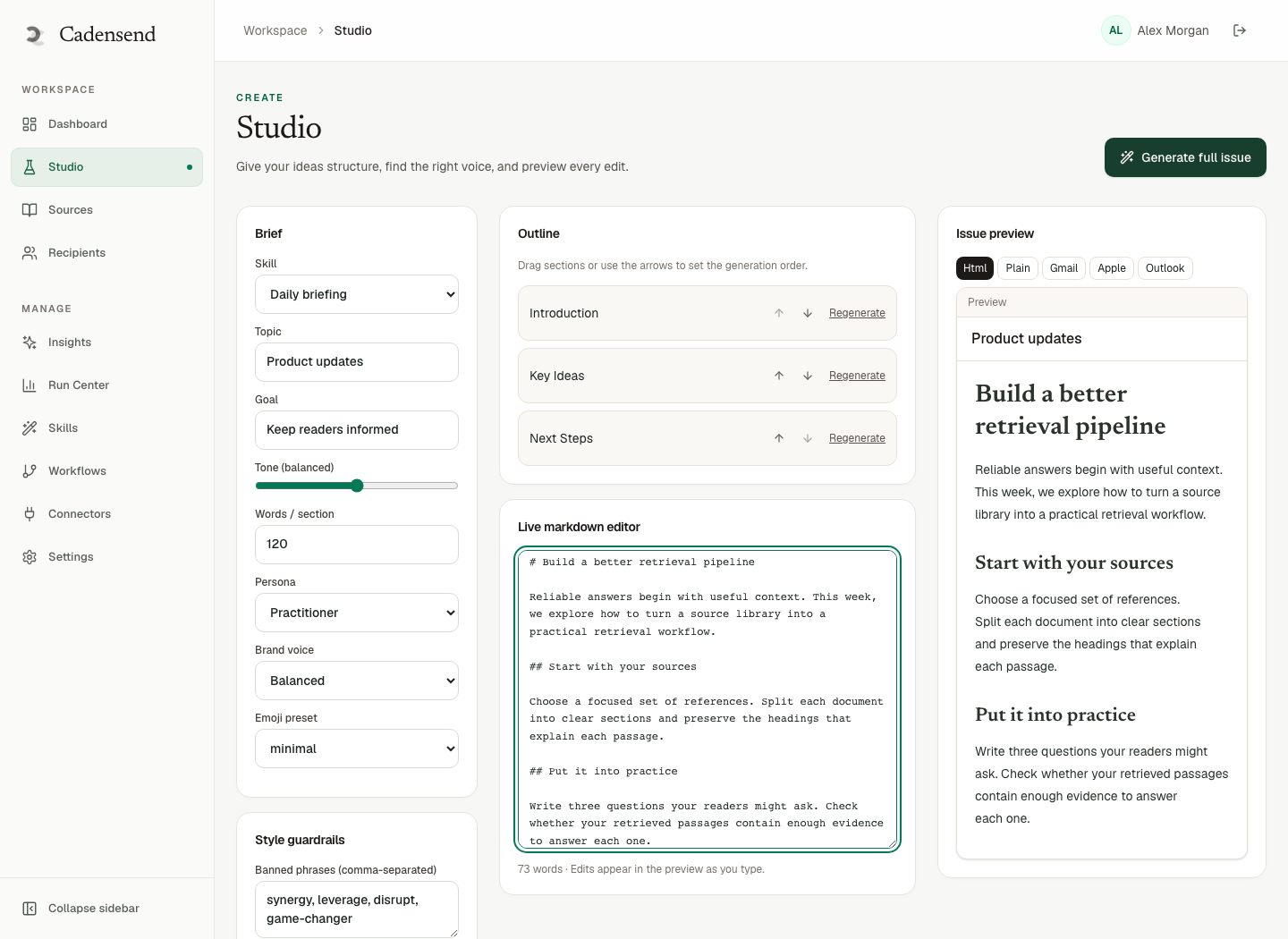
Figure 1: Edit subject and preheader in the curriculum studio — filters read those fields first.
Exactly-Once Sends and Complaint Rate
Short answer: The fastest way to earn junk clicks on a course is to deliver the same issue twice. Learners think you are broken or harvest-y.
Retries are normal. SMTP 421, provider 429, your process dying after the API accepted the message — idempotency in distributed systems is the generic name. For mail, the key must include recipient, issue, and version. Cadensend writes the delivery record before the provider call so a retry replays instead of creating a second MIME. Jobs are claimed with FOR UPDATE SKIP LOCKED, not an in-memory timer that forgets on deploy.
That design targets zero duplicate deliveries. It is the same instinct as system design for 10 million users, applied to one inbox on purpose. Fan-out without this protocol is how newsletters become infamous.
Complaints (the “this is spam” button) are heavily weighted. One duplicate lesson at 6 a.m. after the original at 6 a.m. is enough for a tired reader. Timezone storage (UTC instant plus IANA zone) avoids “I scheduled 8am, DST moved it, I resent it.” See timezone-correct email scheduling.
If you later grow an audience (Cadensend’s later updates: consent, suppression, unsubscribe), complaint rate will dominate Google’s bulk thresholds. Building exactly-once now is cheaper than apologizing later. Compare tools in ConvertKit vs Ghost vs Cadensend before you copy Kit’s retry folklore.
Providers, Warm-Up, and Cadensend Scope
Short answer: Warm-up is for new bulk IPs and new domains sending to many strangers. It is mostly irrelevant for mailing your verified address from a reputable transactional API.
Transactional providers (Postmark, SES, etc.) assume you send wanted mail: receipts, courses the user enrolled in, password resets. They still require authentication. They will shut you off if you upload a scraped list. Cadensend’s FAQ is explicit: no hosted product, no list in MVP, writer has no arbitrary web browse. Copied from the product page: retrieved content is data, never instruction.
Do not:
- Buy a “warm-up service” to mail yourself.
- Run Cadensend as a stealth ESP for a purchased list.
- Mix affiliate blasts on the same subdomain as your syllabus.
Do:
- Use a provider with HTTPS APIs and signed webhooks (Cadensend expects signature-checked, replay-protected callbacks).
- Keep a multipart plain-text alternative. Renderers that emit HTML+text from a block AST beat hand-pasted Gmail docs.
- Watch bounce types. Hard bounces on a single verified address mean you typed the address wrong — fix identity, do not retry forever.
ChatGPT Projects will not do this layer. They hold files in a chat. They do not own SMTP. See ChatGPT Projects vs a personal email syllabus. PKM tools do not own SMTP either. The curriculum engine sits between notes and the provider.
HinterBuild’s RAG/LLM service is the retrieval half. Deliverability is DNS plus provider plus content honesty. We will not pretend an embedding model fixes a missing SPF record.
A Deliverability Checklist for a Personal Series
Short answer: Authenticate, send once, write from sources, schedule locally, and keep the From identity stable.
Use this before you call a lesson “shipped”:
- Domain: SPF, DKIM, DMARC documented; From domain aligned.
- Identity: same From name and address every issue. No “Mary from Finance.”
- Recipient: Cadensend MVP = your verified address only. Do not BCC a hidden list.
- Subject: specific lesson outcome, not bait. Craft in subject lines for learning emails.
- Preheader: completes the subject, does not repeat it. Preheaders and open rates.
- Body: HTML + text; citations resolve to attached sources (attach sources).
- Links: https, no public URL shorteners you do not control.
- Schedule: IANA zone stored with UTC instant.
- Send protocol: idempotent key; no second MIME on retry (idempotent sends).
- Footer: true. If there is no list, do not invent an unsubscribe theater that goes nowhere — and when there is a list, make unsubscribe real.
If retrieval is the weak link, debug the index the way we debug garbage RAG. If the model is inventing papers, that is hallucination, and it will also look like spam because the links 404.
Run Cadensend from the GitHub repository. Clone, do not look for a signup form. For a laptop walkthrough, self-host an email course on your laptop. For “should this even be email,” transactional vs educational.
When you want a human to review DNS plus retrieval together, book time. Company context lives on About. The engineering lead is Abdul Sami on LinkedIn.
Frequently Asked Questions
Does calling a message “educational” bypass spam filters?
No. Providers do not honor an Educational header as a get-out-of-spam card. Authentication, reputation, and user complaints dominate. Honest teaching content helps; the label does not.
Can Cadensend improve my inbox placement for a big list?
Not as a bulk ESP. Cadensend is a self-hosted curriculum engine. The MVP sends to your verified address only. Inbox placement for thousands of strangers is an ESP + consent + reputation problem, which Kit or Ghost plus a provider address — Cadensend does not replace that today.
Do I need to warm up my domain to mail myself?
Usually no, if you use a reputable transactional API and authenticated mail. Warm-up matters when a new domain or IP suddenly emits high volume to many recipients.
Why do duplicate course emails get marked as spam?
Identical repeats look automated and annoying. People hit junk. Cadensend writes the delivery record before the provider call so retries do not create a second send.
Will AI-generated lessons always land in spam?
Not always, but generic unsourced LLM copy shares fingerprints with low-quality bulk. Grounded writing from your sources, real citations, and a text part reduce that overlap.
Is SPF enough without DKIM and DMARC?
SPF alone is fragile (forwarding breaks it). DKIM survives forwarding. DMARC tells receivers what to do on failure. Use all three with alignment.
Should educational and transactional mail share one domain?
Prefer a subdomain split if volumes and complaint profiles differ. A password-reset domain should not inherit a newsletter’s complaint rate. See transactional vs educational email.
Conclusion
- Avoid spam filters for educational email with DNS authentication, honest content, and exactly-once delivery — not with spammy subject tricks.
- Cadensend teaches from sources you supply and mails a verified address in MVP; it is not a bulk sender and has no hosted signup.
- Duplicate sends and invented links hurt reputation as much as missing SPF.
- Subject, preheader, timezone, and retrieval quality are part of deliverability, not decoration.
- When you outgrow one inbox, add consent hardware before you add volume.
Clone Cadensend from GitHub, or contact HinterBuild if you need retrieval and sending wired without cargo-cult warm-up. More about the company is on /about; the engineering lead is on LinkedIn.
Free consultation
Book a free consultation call on educational email deliverability
30-minute call with the HinterBuild team. Discuss your project, architecture questions, or next steps — no obligation.
Book a meeting
Keep reading
Related articles
Transactional vs Educational Email Types
Transactional vs educational email differ in trigger, consent, and retries. Cadensend is a curriculum engine, not a receipt sender.
Read post
Subject Lines for Learning Emails That Work
Subject lines for learning emails name the lesson outcome, not bait. Cadensend edits subject on the issue before an exactly-once send.
Read post
Write a 7-Day Email Onboarding Course
Write a 7-day email onboarding course with objectives, sources, and exactly-once delivery — without treating a curriculum engine like a CRM.
Read post
Turn PDF Notes Into an Email Course
Turn PDF notes into an email course: ingest documents, plan modules, ground every claim, and schedule issues with real citations.
Read post