
ConvertKit vs Ghost vs Cadensend Compared
ConvertKit vs Ghost vs Cadensend is not a three-way race. One is a creator CRM, one is a CMS newsletter, and Cadensend is a self-hosted curriculum engine.

Muhammad Abdul Sami
· 12 min read
- Email Courses
- PKM
- Citations
- Self-Hosting
ConvertKit vs Ghost vs Cadensend is a search people type when they want one tool to “send a course by email.” That comparison is useful only if you name what each product actually does. ConvertKit (now Kit) is a hosted creator marketing platform. Ghost is an open-source publishing CMS with newsletters. Cadensend is an MIT-licensed, self-hosted email curriculum engine: it plans a series from a learning goal, writes issues grounded in sources you supply, and delivers each approved issue exactly once. There is no hosted Cadensend signup.
This post is for people who keep notes and papers and want a syllabus in their inbox — not a blast list. If you need a bulk sender or a membership paywall, Cadensend is the wrong product. If you want citations that point at real sections, scoped retrieval, and a scheduler that does not double-send after a restart, it is the right class of tool. HinterBuild ships it as open source on GitHub. Wiring questions belong in a consultation.
Key Takeaways:
- ConvertKit is a hosted marketing CRM with sequences; Ghost is a CMS that can send newsletters; Cadensend is a self-hosted curriculum engine with no hosted signup.
- Cadensend’s MVP delivers only to your verified address. It is not a bulk sender and will not replace Kit or Ghost for audiences.
- Grounded writing means every claim traces to a source you attached, with structural citations rendered after the model returns references — not invented footnotes.
- Exactly-once delivery is an architecture choice (write the delivery record before the provider call), not a hope that SMTP is unique.
- Pick the tool for the job: grow a list in Kit, publish a magazine in Ghost, turn a PKM corpus into a personal email series in Cadensend.
Table of Contents:
- What Each Product Is For
- ConvertKit vs Ghost vs Cadensend Feature Matrix
- Grounded Writing and Citations
- PKM to Email Series Workflow
- Delivery Semantics: Marketing vs Exactly Once
- Cost, Hosting, and Roadmap Honesty
- A Practical Decision Tree
- Frequently Asked Questions
What Each Product Is For
Short answer: ConvertKit is for growing and monetizing an audience. Ghost is for publishing a site and sending that writing as email. Cadensend is for turning one learning goal plus your sources into a structured series.
ConvertKit’s own product (rebranded as Kit) is built around subscribers, visual automations, landing pages, and creator commerce. You import a list, tag people, and drip a sequence. That is a legitimate job. It is not citation-aware retrieval, and it is not a curriculum validator.
Ghost is a Node.js publishing platform. You write posts, members subscribe, and Ghost hands mail to a provider such as Mailgun. Editorial workflow is first-class. Curriculum planning, scoped retrieval, and structural citations are not.
Cadensend is narrow on purpose: Plan, Ground, Write, Deliver. A planning graph turns a brief into modules, then checks coverage and prerequisite order. You upload files or URLs. Structure-aware ingestion keeps headings and tables and records section anchors. The writer is bounded: retrieve, write, critique, gate, revise. The model returns a content tree; a renderer produces HTML. Delivery keys on workspace, issue, recipient, and issue version. The current build sends only to your verified address.
The HinterBuild team built Cadensend because we kept watching people paste a vault into ChatGPT, get a “lesson 1,” and then watch the model invent a paper that does not exist. That failure mode is documented in LLM hallucination causes and fixes. A marketing ESP will not fix it. A CMS will not fix it. Grounding plus structural citation rendering will.
If you already run RAG and LLM systems, Cadensend is the teaching surface on those same ideas: scoped retrieval, embeddings, and a write path that cannot silently invent sources.
ConvertKit vs Ghost vs Cadensend Feature Matrix
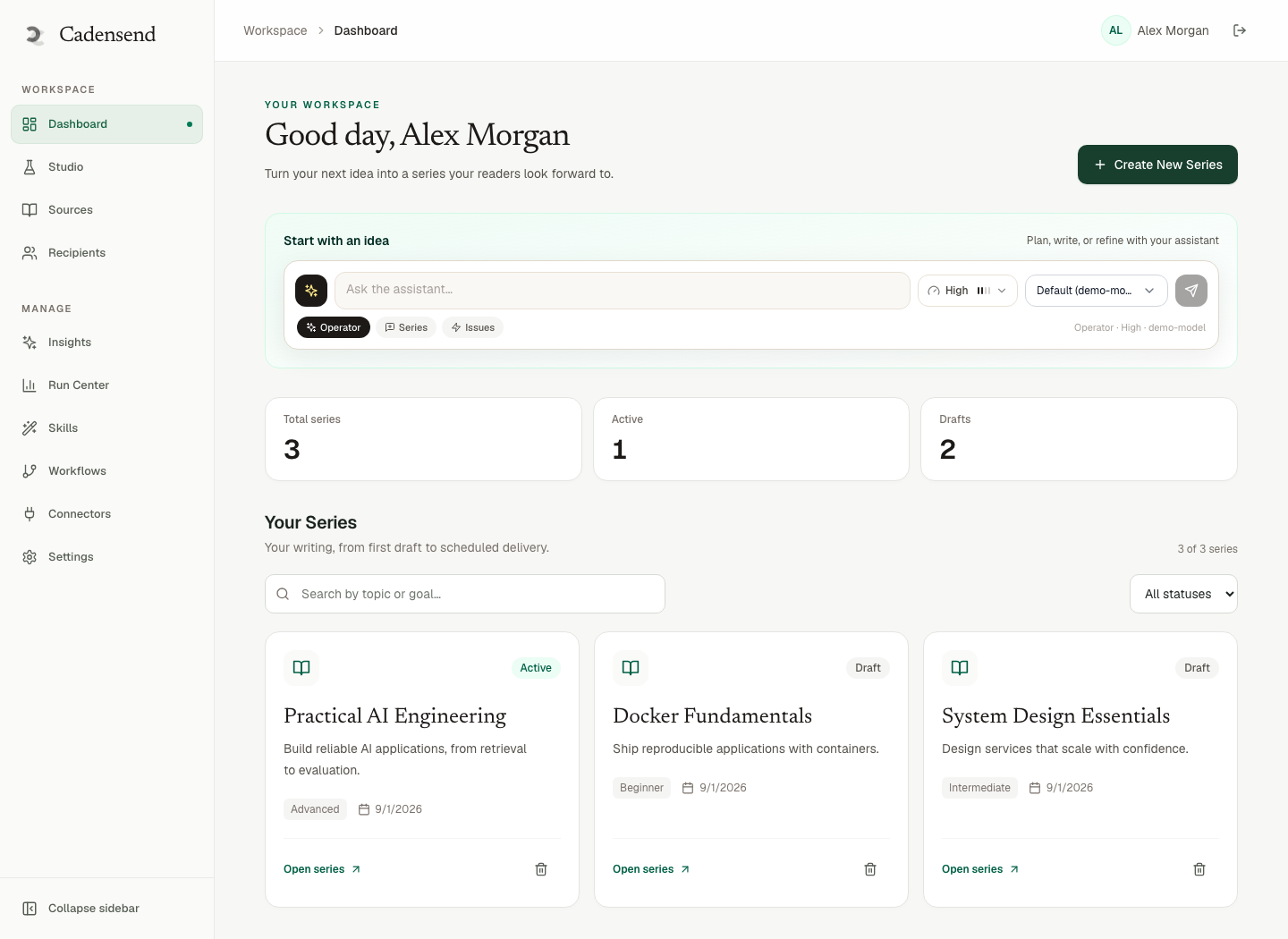
Figure 1: Cadensend’s dashboard is a set of learning series, not a subscriber CRM.
| Capability | ConvertKit / Kit | Ghost | Cadensend |
|---|---|---|---|
| Hosted signup | Yes | Ghost(Pro) hosted or self-host | No hosted signup; clone and run |
| License | Proprietary SaaS | MIT (Ghost itself) | MIT |
| Primary object | Subscriber + automation | Post + member | Series + issue + source |
| Curriculum validation | Sequences you design by hand | None | Coverage and prerequisite checks |
| Citations from your files | No | No | Structural citations from supplied sources |
| Scoped retrieval | N/A | N/A | Workspace and series filters before the vector store |
| Audience size (today) | Lists of any size you pay for | Members / newsletter | MVP: verified address only |
| Exactly-once send semantics | Provider + your automation hygiene | Provider + Ghost’s send pipeline | Delivery record before provider call; retries replay |
| Timezone-aware scheduling | Automations with delay units | Newsletter send time | UTC instant stored beside IANA zone |
| Bulk marketing | Yes | Newsletter, not a full ESP | Explicitly not a bulk sender |
| CRM / tags / commerce | Yes | Memberships, paid tiers | No |
Read that table twice. “Open source” is not a synonym. Ghost is open source publishing. Cadensend is open source curriculum delivery. Kit is neither; it is a productized marketing stack, and it is good at that.
People who treat Cadensend as “the free ConvertKit” will be angry. The MVP will not mail a cohort. Opt-in audiences, consent, suppression, unsubscribe, and analytics are later updates, gated on those controls being real. That is documented on the product page and in the repository.
If you need a list-growth comparison among hosted ESPs, stop here and use Kit’s docs. If you need a public archive of essays, use Ghost. If you need a personal syllabus that does not hallucinate citations, keep reading — and pair this with how to attach sources so AI does not invent citations.
Grounded Writing and Citations
Short answer: Grounded writing means the model may only claim what retrieval returned, and citations are rendered from stored chunk IDs — not from free-text “according to Smith 2019.”
Kit and Ghost both assume you wrote the email. That is honest. You can still paste ChatGPT output into either tool and ship a fabricated footnote. The ESP will deliver the lie with excellent inbox placement.
Cadensend inverts the contract. You attach sources. Ingestion is content-hash keyed and resumable: fetch, parse, chunk, embed, verify. Queries are filtered to workspace and series before they hit the vector store, then deduped and diversified by source. That is the same discipline we preach when a RAG pipeline returns garbage: if the index is unscoped, the model will cheerfully quote the wrong tenant’s PDF.
The model returns source and chunk references. A deterministic renderer turns those into links. Citations cannot be fabricated in the HTML because the renderer will not emit a citation that is not in the retrieval set. That is a different architecture from “please cite your sources” in a system prompt. Prompt-only citation is a suggestion. Structural citation is a gate.
This is why embeddings and RAG vs fine-tuning vs prompting belong here: you are choosing whether teaching text is generated against a closed corpus. ChatGPT Projects can hold files; they are not a delivery engine — see ChatGPT Projects vs a personal email syllabus.
PKM to Email Series Workflow
Short answer: A personal knowledge management (PKM) vault becomes an email series when you treat notes as sources, a learning goal as a plan, and the inbox as a spaced delivery rail.
Typical PKM tools (Obsidian, Logseq, a folder of PDFs) are excellent at capture and terrible at sequenced teaching. You search, you reread, you feel busy. An email series forces a syllabus: issue 1 before issue 4, one outcome per issue, a cadence you will actually open.
A Cadensend-shaped workflow: state the outcome, attach the notes that are allowed to be true, let planning produce modules, generate each issue against retrieval, edit subject and preheader, schedule in the learner’s IANA timezone, and deliver once. ConvertKit can drip a sequence you wrote. Ghost can send the week’s post. Neither will validate that issue 3 does not assume issue 7, and neither will keep retrieval inside one series so yesterday’s marketing PDF cannot contaminate today’s lesson — the teaching analogue of why RAG pipelines return garbage.
Laptop ops: self-host an email course on your laptop. DST: timezone-correct email scheduling. Company context is About; corpus wiring is RAG / LLM systems. None of that is a Kit migration.
Delivery Semantics: Marketing vs Exactly Once
Short answer: Marketing platforms optimize for throughput and retries that “eventually send.” A curriculum engine should optimize for zero duplicate deliveries of the same issue version to the same recipient.
Kit and Ghost sit on SMTP providers. Providers retry. Your worker retries. A deploy kills a process after the provider accepted the mail but before you marked the job done. The next worker sends again. Learners get lesson 4 twice and skip lesson 5 because they marked both as “already read.” That is not a branding problem. It is idempotency in distributed systems.
Cadensend’s delivery record is written before the provider call, keyed on workspace, issue, recipient, and issue version. A retry returns the original attempt. Jobs are claimed from Postgres with FOR UPDATE SKIP LOCKED — a durable queue, not an in-memory timer that forgets on deploy. Engineering targets from the design blueprint: 0 duplicate deliveries tolerated, scheduler claim lag under 60s p95, approved-send lag under 2 minutes p95.
That is the same reliability posture you want when you design for 10 million users, even though Cadensend’s MVP audience is one verified inbox. Semantics first, fan-out later. If you want the plain-language version, see idempotent email sends explained simply.
Marketing ESPs will talk about deliverability, dedicated IPs, and warm-up. Those topics matter if you mail thousands of strangers. They are the wrong first conversation for a personal syllabus. For educational mail that does leave your laptop for a real inbox, still follow how to avoid spam filters for educational email. Cadensend does not replace SPF, DKIM, and DMARC. It replaces “the cron job fired twice.”
Do not confuse transactional mail (password resets, receipts) with educational mail (syllabus issues). We unpack that split in transactional vs educational email. Kit blurs them because both go through the same ESP. Cadensend does not send password resets.
Cost, Hosting, and Roadmap Honesty
Short answer: Kit charges for subscribers. Ghost charges for Ghost(Pro) or you run it. Cadensend’s software is free; you pay LLM, email provider, and the machine you run it on.
Kit’s pricing is list-sized. That is correct for a CRM. Ghost(Pro) is a hosted CMS bill; self-hosted Ghost is your VPS. Cadensend has no hosted SKU. Clone the MIT repo. Bring an LLM key and a transactional provider if you want mail to leave the box. The writer has no arbitrary network or code-execution tool. Retrieved text is data, never instruction — the same prompt-injection boundary we care about in production RAG.
Roadmap, so nobody is sold a fantasy:
| Release | Focus | Audience |
|---|---|---|
| MVP (current) | Plan, grounded generation, schedule, deliver to one verified recipient | Individual learner / creator |
| Update 1 | Hybrid retrieval, rerank, citation coverage scoring, OCR, charts | Technical educators |
| Update 2 | Opt-in audiences, consent, suppression, unsubscribe, analytics | Newsletter creators |
| Update 3 | Segments, quizzes, progress, branching, multilingual issues | Learning businesses |
| Update 4 | Roles, SSO, SAML, SCIM, audit, residency | Companies / training teams |
| Update 5 | Public API, webhooks, LMS/CMS, marketplace | Partners |
Until Update 2 exists, comparing Cadensend’s “list size” to Kit is a category error. Until you need a public theme and memberships, comparing it to Ghost is a category error.
Subject lines and preheaders still matter once mail is real. Cadensend’s editorial workspace edits both. For craft, see subject lines for learning emails and preheaders for learning emails. Those skills transfer to Kit and Ghost. The grounding layer does not.
If you want that retrieval stack built for a team corpus, contact HinterBuild.
A Practical Decision Tree
Short answer: Choose Kit to grow and sell to a list, Ghost to publish a site plus newsletter, Cadensend to teach yourself (or a future audience) from a closed corpus with exactly-once delivery.
Use ConvertKit / Kit when you want subscribers, tags, automations, landing pages, and commerce, and you are the author of the copy.
Use Ghost when the canonical artifact is a web post, email is distribution, and you want memberships plus a theme you control (self-host or Ghost(Pro)).
Use Cadensend when the canonical artifact is a curriculum, sources must be files you supplied with structural citations, duplicate lesson delivery is unacceptable, you will run the software yourself, and you accept MVP scope: your verified address only.
Use more than one when you draft grounded issues in Cadensend, then manually publish a public version in Ghost after review, and keep Kit for the marketing list. Generation is grounded; distribution to strangers is a later product with consent hardware. Mixing those layers is how people get both hallucinations and spam-folder mail.
For retrieval internals, stay with embeddings and RAG vs fine-tuning vs prompting. For send safety, idempotency and idempotent sends in plain language. For local ops, self-host on a laptop.
Frequently Asked Questions
Is Cadensend a ConvertKit alternative?
No. ConvertKit is a hosted creator marketing platform with lists, automations, and commerce. Cadensend is a self-hosted email curriculum engine with no hosted signup. It does not grow a list, and the MVP cannot send to a mailing list.
Is Cadensend a Ghost alternative?
No. Ghost is a publishing CMS with memberships and newsletters. Cadensend does not replace your blog theme, paywall, or public archive. It plans, grounds, writes, and delivers a series from sources you attach.
Can I sign up for hosted Cadensend?
No. There is no hosted signup. Clone the MIT repository and run it yourself. You pay your LLM provider, your email provider, and your infrastructure.
Does Cadensend send to a mailing list today?
Not yet. The current build sends only to your own verified address, by design. Opt-in audiences, consent, and suppression are later work, gated on those controls being hardened first.
Why would I use Cadensend instead of pasting ChatGPT into Kit?
Because Kit will faithfully send whatever you paste, including invented citations. Cadensend retrieves from sources you supplied, scopes queries to the series, and renders citations from chunk references the model cannot freely invent in HTML.
How does Cadensend avoid sending the same issue twice?
Delivery is keyed on workspace, issue, recipient, and issue version. The delivery record is written before the provider call. A retry returns the original attempt instead of creating a second send.
Conclusion
- ConvertKit vs Ghost vs Cadensend is a category question, not a feature-checkbox race.
- Kit is for audiences. Ghost is for publishing. Cadensend is for a grounded email curriculum you host yourself.
- Citations that survive review come from sources plus a renderer, not from a polite prompt.
- Exactly-once delivery is a database protocol, which is why Cadensend writes the send record first.
- MVP honesty: one verified recipient, MIT license, no hosted signup.
If you are building a personal syllabus from a PKM corpus, start with Cadensend and the GitHub repo. If you need a team to wire retrieval, citations, and delivery into something you already run, contact HinterBuild, read who we are, or reach the engineering lead on LinkedIn.
Free consultation
Book a free consultation call on Cadensend vs ConvertKit vs Ghost
30-minute call with the HinterBuild team. Discuss your project, architecture questions, or next steps — no obligation.
Book a meeting
Keep reading
Related articles
Self-Host an Email Course on Your Laptop
Self-host an email course on your laptop with Cadensend: clone the MIT repo, attach sources, and send grounded issues to yourself.
Read post
Teach With Sources, Not AI Vibes in Email
Teach with sources, not AI vibes: ground every educational email in files you supply, with citations the model cannot fabricate.
Read post
Cite Sources in Educational Emails Correctly
Cite sources in educational emails without fake footnotes: structural citations, retrieval grounding, and a reviewer checklist that catches invented refs.
Read post
ChatGPT Projects vs a Personal Email Syllabus
ChatGPT Projects hold files for chat. A personal email syllabus sequences grounded issues. Cadensend is the engine for the second job.
Read post