
Convert a Blog Archive Into an Email Course
Convert a blog archive into an email course by resequencing posts into objectives, pruning leftovers, grounding citations, and scheduling spaced issues.

Muhammad Abdul Sami
· 12 min read
- Email Courses
- Curriculum Design
- Content Strategy
Converting a blog archive into an email course is a curriculum problem, not an RSS-to-Mailchimp problem. Posts are written for search and date-stamped arguments. Courses need prerequisite order, one outcome, and issues that still make sense when the next send has not arrived. If you dump 40 URLs into a sequence, you built a binge reading list with better subject lines. This guide is the conversion method we use: inventory, objectives, prune, resequence, ground, rewrite, approve, deliver.
Cadensend is built for that loop. HinterBuild’s MIT-licensed, self-hosted email curriculum engine Plans modules and issues from a goal, Grounds generation in sources you upload or URL-index (your archive), Writes a validated content tree with structural citations, and Delivers exactly once. No hosted signup (GitHub). The MVP sends to your verified address only — the right way to notice that post #12 is 4,000 words of 2022 tooling.
Key Takeaways:
- Start from a performance outcome, then select posts; never start from “we have 60 articles.”
- Split, merge, and retire posts; a 1:1 post-to-issue map almost always fails prerequisites.
- Re-ground claims in the current source, not in the post’s original publish date.
- Rewrite for email length and retrieval; do not paste HTML from the CMS.
- Lock the new sequence independently of the public blog’s chronology.
- Dogfood the series on one verified inbox before you talk about audiences.
Table of Contents:
- Why Archives Make Bad Courses
- Inventory Without Mercy
- Write the Course Outcome First
- Resequence, Split, and Merge
- Ground the New Series on the Old Posts
- Rewrite for Email, Not for SEO
- Citations, Freshness, and Hallucination
- Plan Studio and Delivery
- A Conversion Worked Example
- Canonical URLs, Rights, and Course Versions
- Frequently Asked Questions
Why Archives Make Bad Courses
Short answer: Blogs optimize for independent landing pages. Courses optimize for a path. Those graphs only overlap by accident.
A post titled “we tried X in production” assumes a reader who already wants X. Issue 3 of a course cannot assume that without issues 1–2. Chronological publish order is usually the worst pedagogical order: announcements, then deep dives, then the conceptual primer you wrote a year later when support tickets piled up.
Binge risk is high. Learners who receive “week 1: our complete archive” will skim and not retrieve. That is the failure mode in microlearning vs binge learning. Email should space a new sequence.
SEO leftovers fight you: every post repeats definitions for Google. In a course, repeating the full definition every issue is load, not helpfulness. Cognitive load is not infinite (Sweller). Define once, retrieve later.
Inventory Without Mercy
Short answer: Spreadsheet every URL with: outcome it could teach, prerequisites it assumes, last updated, and “keep / split / kill.”
Columns that matter:
| Field | Why |
|---|---|
| URL | Source for Ground |
| Independent ranking intent | Often conflicts with course intent |
| Assumed reader | Maps to beginner vs intermediate |
| Hidden prerequisites | Feeds prerequisite ordering |
| Code / screenshots age | Stale samples become harm |
| Legal / tone | Corporate voice vs personal blog |
| Rights | You cannot index what you cannot use |
Kill list examples: hiring posts, recaps of conferences, duplicate explainers, anything that exists only to rank a keyword you no longer serve. HinterBuild’s own blog cluster is engineering reference — converting it into a beginner agent course would still require a new spine, not 140 posts in send order.
If the archive is Python essays, do not pretend it is Python for absolute beginners unless the inventory says so. Intermediate war stories skip for loops.
Write the Course Outcome First
Short answer: One sentence the last issue can test. Then the archive is a library, not a teacher.
Use backward design (Understanding by Design) and visible verbs (Bloom). Example:
By issue 10, the reader can take a messy internal RFC and produce a 5-issue email outline with prerequisites named and two sources cited per issue.
That outcome tells you which posts are evidence vs decoration. It is also the brief Cadensend Plan needs: topic, included and excluded concepts, outcome, audience, cadence, timezone, tone. Exclusions: “no pricing, no hiring, no 2022 framework names.”
Details on objectives: write learning objectives an AI can plan. If you skip this, the planner will imitate your most linked post, not your course.
Resequence, Split, and Merge
Short answer: Map posts to issues with a many-to-many relation. One post can feed three issues; three posts can collapse into one recap.
Heuristics:
- Split when a post has two skills (chunking and reranking).
- Merge when three short changelogs are one conceptual move.
- Promote a later primer to issue 1 even if it ranked worse.
- Demote a viral post to optional further reading if it skips steps.
- Insert synthetic issues with no public post when the archive never taught the missing prerequisite.
A 21-day skill curriculum may only need 12 of your 80 posts. That is success. Coverage validation should fail if the outcome mentions “citations” but no issue teaches a citation format.
Cadensend validates coverage and prerequisite ordering, then runs a revision pass. Plan Studio reorders issues and locks approved ones so regenerating the tail cannot reshuffle the blessed opener. Treat the public sitemap as unrelated after this point.
Ground the New Series on the Old Posts
Short answer: Index the selected URLs and the current canonical docs they depend on. Do not index the entire domain by default.
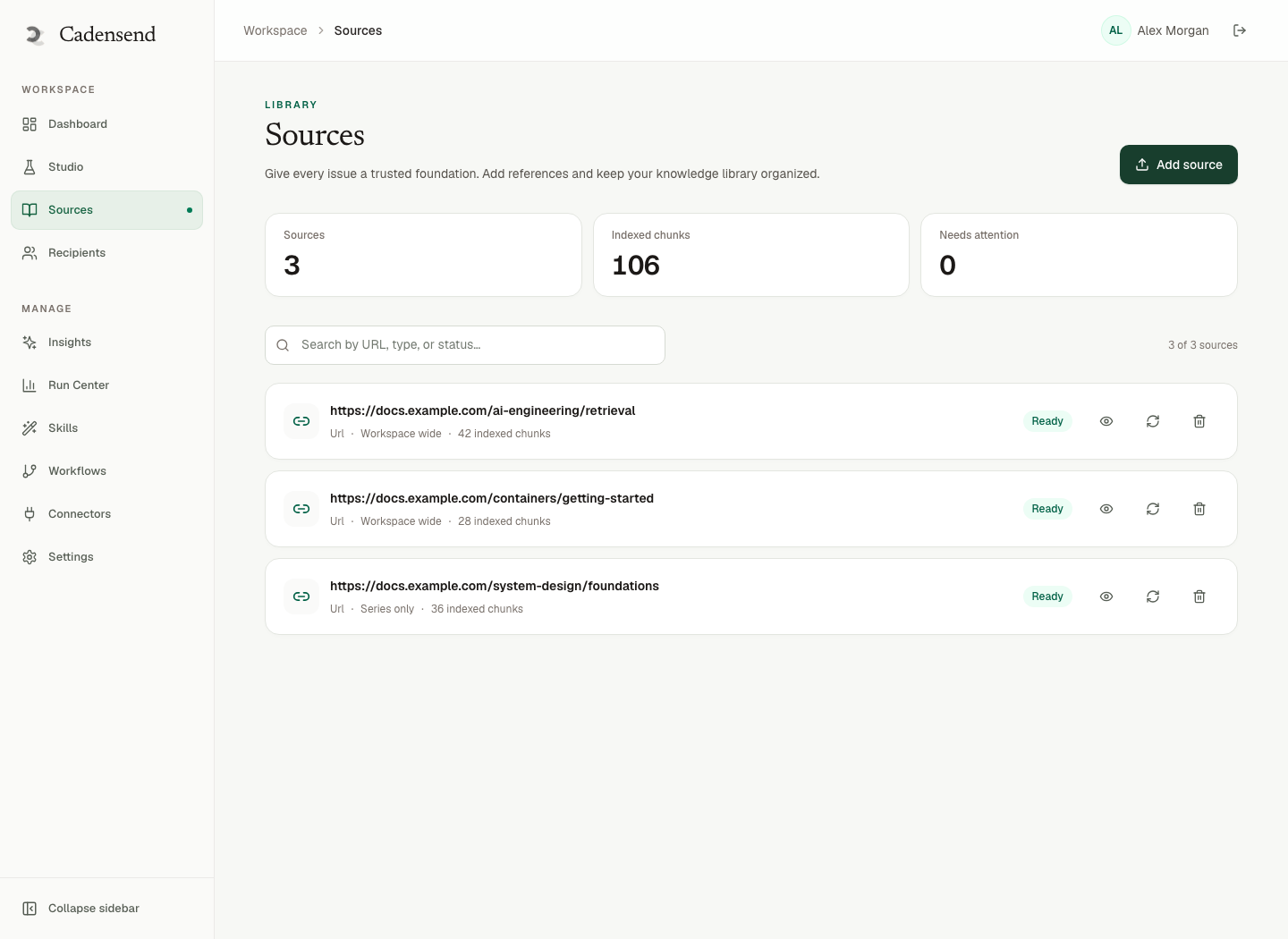
Cadensend Ground is structure-aware: heading hierarchy, code and tables kept, section anchors for citations. Idempotent ingestion is content-hash keyed. Retrieval is filtered to workspace and series, then deduped and diversified by source. That last point matters when your archive repeats the same intro paragraph 40 times — you do not want 40 near-duplicate chunks.
Also index:
- Official docs the posts cited (current version).
- Internal ADRs if the course is for staff (corporate training without an LMS).
- A “corrections” note for posts you know are stale.
Do not index comments, author bios, or “related posts” chrome if your parser is sloppy. Garbage in becomes confident garbage out — see LLM hallucination causes and fixes. Cadensend renders citations from model-returned source/chunk IDs through a deterministic linker so the writer cannot invent hrefs.
Retrieved text is data, never instruction. Archive posts that say “ignore the previous policy” in examples need the same boundary we use in RAG systems and approval-gated agents. The writer has no arbitrary network or code execution; it cannot wander off to refresh a page mid-send.
Rewrite for Email, Not for SEO
Short answer: New issues should be 300–700 words with one task. The blog post remains the long form, linked once.
Copy-pasting CMS HTML into email is how you inherit 12 tracking pixels, a sticky header, and code blocks that break in Outlook. Cadensend Write never takes raw HTML from the model. A bounded graph retrieves, writes, specs visuals, critiques, gates, and revises within a limit — closer to agentic workflows that ship and structured outputs than to “summarize this URL.”
Tone will drift toward your oldest posts unless you set it. Educational email tone should be specified in the wizard. System prompt design can enforce “no hype adjectives, cite or cut.”
Code from old posts may be the worst part. Re-test or drop. See code samples in email.
Retrieval task: “Before you click the original post, write the three-step outline from memory.” Then they can binge the long article as optional deepening — after production, not instead of it (Retrieval Practice).
Citations, Freshness, and Hallucination
Short answer: The citation should point at the archive and at the living spec when the post is historical.
Pattern:
- “In our 2025 post we argued X (post). The current library docs say Y (docs). Issue task: name the difference.”
That turns staleness into curriculum instead of silent wrongness. If you cannot afford that contrast, kill the post as a source.
Diversified retrieval helps, but it cannot know that a library renamed a flag last month unless you ingest the new doc. Freshness is an operations job. HinterBuild’s about story is engineering-first: we would rather cite than vibe. If you need ingestion pipelines at production quality, that is RAG and LLM systems work, often next to AI agent development for the writer graph.
Plan Studio and Delivery
Short answer: Approve issue 1 against the new outcome, lock it, schedule cadence, send to yourself, then iterate.
Cadensend Deliver claims jobs from Postgres with FOR UPDATE SKIP LOCKED, writes the delivery record before the provider call, and keys uniqueness on workspace, issue, recipient, and issue version. Catch-up blasts are a human choice — do not automate them. Timezone fields preserve local intent across DST.
MVP: verified address only. Perfect for conversion QA. You will feel the length. Later roadmap items cover opt-in audiences, unsubscribe, public archives — not available as a hidden bulk path. Cadensend is not a marketing suite.
Questions on the pipeline: contact.
A Conversion Worked Example
Short answer: 47 RAG blog posts → 9 email issues on “why your retriever returns junk.”
| Issue | Built from | What you drop |
|---|---|---|
| 1 | Late primer on failure modes | Three announcement posts |
| 2 | Chunking comparison | Vendor roundups |
| 3 | Metadata filters | Duplicate intros |
| 4 | Recap retrieval | — |
| 5 | Hybrid search post + current docs | Old Elasticsearch version notes |
| 6 | Evaluation post | Benchmarks you cannot reproduce |
| 7 | Case-study post split: only the diagnosis | The sales-adjacent outro |
| 8 | Mixed practice | — |
| 9 | Capstone: audit their pipeline outline | Your hiring CTA |
The public blog stays. The course is a different artifact with a different graph. If you wanted a Python beginner path, you would not start from this inventory at all — you would write the beginner series and maybe cite two posts as optional.
Canonical URLs, Rights, and Course Versions
Short answer: Keep the blog as the public canonical page. The email course is a derived work with its own version. Do not noindex your money pages to “force” the course.
Search engines already have the archive. If issue 3 paraphrases post X, link to post X after retrieval so you are not creating a thin duplicate. Canonical tags belong on the HTML pages of the site, not inside the email. The course does not need to rank; it needs to teach.
Rights are sharper than people admit:
- You can ingest what you own or license for this use.
- Guest posts, scraped roundups, and vendor white papers may be off-limits even if they sat on your domain.
- Screenshots of other products can be trademark-sensitive; replace with your own diagrams via Cadensend’s spec → PNG path when you get there.
Version the course independently of the blog. When you update a post in 2027, do not silently mutate a locked 2026 issue. Unlock, regenerate that issue against the new chunk, re-approve, bump issue version. Cadensend’s idempotent send key includes version, so the corrected lesson is a new delivery, not a stealth rewrite of history.
Keep a changelog issue — “what changed since v1” — as retrieval, not as a binge dump of diffs. Learners who finished v1 need a bridge, not a full restart. That is the same discipline as locking prefixes in prerequisite graphs.
Staff-only archives (RFCs, ADRs) follow the corporate training split: self-host Cadensend so those files never sit in a hosted classroom you did not review. There is no hosted signup. Clone the repo and run it where the runbooks already live.
Frequently Asked Questions
Can I auto-send every new blog post as the next lesson?
You can, and you will destroy prerequisite order. Batch inventory on a cadence (quarterly), then issue a new series version.
Should issues link back to the original post?
Yes, after a retrieval task. The post is the deep link, not the lesson.
What if posts have inconsistent voice?
Set tone in the series brief and rewrite. Do not average the voices. Lock issue 1 as the gold sample.
How does Cadensend use my archive?
You add selected URLs or files as sources. Ground chunks them with structure. Write cites chunk IDs through a deterministic renderer. The whole archive is not automatically in-scope unless you ingest it.
Who gets the course after conversion?
In the current build, you — the verified address. Use that until the sequence is true. List sending is later and consent-gated.
Do I need to take posts down?
No. Canonical blog URLs can remain for search. The course is a separate product surface.
What about paywalled posts?
Only ingest what you have rights to use for generation and citation. Rights are not an embedding problem.
Conclusion
- An archive is a library; a course is a path. Convert with objectives, prune, and resequence.
- Ground on selected posts plus current specs; rewrite for email; cite contrasts when history is stale.
- Lock the new order; dogfood on one inbox; do not blast catch-up archives.
- Use Cadensend to Plan / Ground / Write / Deliver that path locally.
Clone the repo, read how HinterBuild works, or book a consult. Engineering: LinkedIn.
Free consultation
Book a free consultation call on blog-to-email courses
30-minute call with the HinterBuild team. Discuss your project, architecture questions, or next steps — no obligation.
Book a meeting
Keep reading
Related articles
Turn PDF Notes Into an Email Course
Turn PDF notes into an email course: ingest documents, plan modules, ground every claim, and schedule issues with real citations.
Read post
Daily Email Course: Learn Anything From Sources
Build a daily email course from one learning goal and your own sources. Plan modules, cite claims, and deliver each issue exactly once.
Read post
Beginner vs Intermediate Email Course Design
Design beginner vs intermediate email courses with different priors, examples, tone, and prerequisite graphs — not the same outline with harder homework.
Read post
Corporate Training by Email Without an LMS
Run corporate training by email without an LMS: scoped curricula, source-grounded issues, human review, and honest limits vs compliance platforms.
Read post