
Write Learning Objectives an AI Can Plan From
Write learning objectives an AI planner can use: observable verbs, exclusions, audience, and coverage tests that turn a brief into a real curriculum.

Muhammad Abdul Sami
· 12 min read
- Learning Objectives
- Curriculum Design
- AI Planning
Learning objectives an AI can plan from are not motivational slogans. They are contracts: observable performance, constraints, audience, and evidence. A human instructional designer infers what you meant by “master RAG.” A planning graph cannot. If you want a model to propose modules, issues, and prerequisite order, you have to write objectives the way you would write an acceptance test. This guide is that style guide, mapped onto Cadensend’s Plan stage.
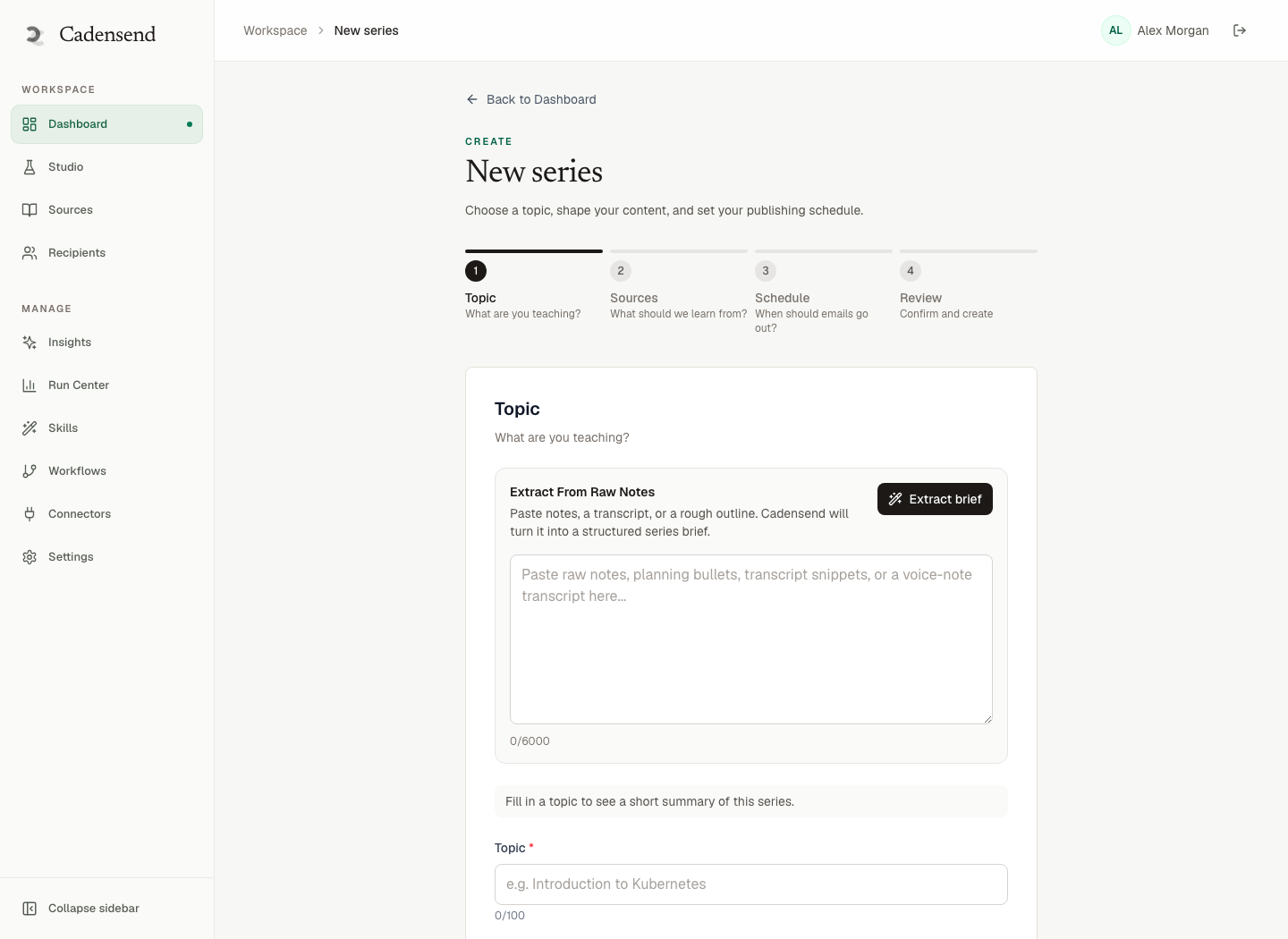
Cadensend is HinterBuild’s MIT-licensed, self-hosted email curriculum engine. You describe topic, inclusions, exclusions, outcome, audience, cadence, timezone, and tone. A LangGraph planner turns the brief into a structured plan, then validates coverage and prerequisite ordering. Ground, Write, and Deliver come after the contract is real. No hosted signup (GitHub). The MVP sends only to your verified address, so a vague objective becomes your confusing Tuesday email, not a thousand learners’ problem.
Key Takeaways:
- Replace “understand” with a verb you can film: write, repair, classify, cite, refuse.
- Put exclusions in the objective set; planners treat silence as permission to add popular topics.
- State audience level as prior skills, not as a marketing persona.
- Attach evidence: what artifact proves the objective on the last issue.
- Validate coverage against those artifacts before anyone writes prose.
- Lock approved objectives so a rewrite of issue 18 cannot change what issue 1 was for.
Table of Contents:
- Why Models Fail on Soft Objectives
- The Contract: Performance, Conditions, Evidence
- Verbs That Survive a Planner
- Inclusions, Exclusions, and Scope Knives
- Audience as Prior Skills
- Coverage and Prerequisite Tests
- From Objectives to Email Issues
- Prompts Are Not a Substitute for the Brief
- A Full Objective Set You Can Copy
- Anti-Patterns and Time Calibration
- Frequently Asked Questions
Why Models Fail on Soft Objectives
Short answer: Soft objectives maximize plausible syllabus shape. They do not constrain tokens in examples.
“Understand Python,” “get confident with email,” “learn AI” all share a failure: the planner can emit any popular outline and claim coverage. You will get classes before for loops, or a marketing funnel in week one of a teaching series. That is not a model personality. It is an underspecified loss function.
The same failure appears in ungrounded generation: without sources, the writer fills gaps with hallucinated APIs. Without objectives, the planner hallucinates a profession. Cadensend separates Plan from Write so you can reject a graph before HTML exists. That is agentic workflow hygiene: do not let the writer invent the spec.
Bloom’s taxonomy is still the cheapest shared vocabulary for observable cognition (Vanderbilt overview). Use it as a verb filter, not as a shrine.
The Contract: Performance, Conditions, Evidence
Short answer: One sentence that names the performance, the conditions (tools, time, forbidden aids), and the evidence.
Mager-style objectives survive automation because they are testable. Backward design says start from evidence (Understanding by Design). Combine them:
Performance: Draft a 5-issue outline for a single skill.
Conditions: Using only the supplied source pack; 45 minutes; no new libraries.
Evidence: Each issue lists teaches / assumes; two source sections cited; exclusions honored.
Cadensend’s wizard fields map onto this contract:
| Wizard field | Contract piece |
|---|---|
| Topic | Domain name |
| Included concepts | Performance ingredients |
| Excluded concepts | Negative conditions |
| Outcome | Performance + evidence |
| Audience level | Prior conditions |
| Cadence / timezone | Delivery conditions (part of instruction) |
| Tone | Voice constraint on Write |
If your outcome cannot fill that table, do not generate. Contact HinterBuild if you are stuck between a workshop and a newsletter — about the team.
Verbs That Survive a Planner
Short answer: Prefer production and diagnosis verbs. Ban “understand,” “know,” “appreciate,” “be familiar with,” “explore.”
| Weak | Stronger replacement |
|---|---|
| Understand joins | Write a JOIN and explain a dropped row |
| Know REST | Classify methods and idempotency for 5 routes |
| Explore Python | Run a 15-line script that filters a list of dicts |
| Appreciate security | Refuse a prompt-injection-like source quote and say why |
| Learn email pedagogy | Produce one issue with objective, example, retrieval task |
For teaching-about-teaching series, strong verbs include sequence, split, lock, cite. Those map to prerequisite ordering and 21-day curricula.
Evaluation-driven teams already write assertions first (evaluation-driven development). Do the same for learning. If you cannot write a failing check, the objective is still mush.
Inclusions, Exclusions, and Scope Knives
Short answer: Inclusions are not a tag cloud. They are concepts that must appear. Exclusions must not appear in samples.
A planner given “Python, data, real world” will include pandas because the internet did. A planner given “lists, dicts, def; exclude pandas, classes, async, files” can be failed when issue 4 imports DataFrame.
Exclusions also stop archive poisoning when you convert a blog. Your old “we use Kubernetes” post is a source, not a license to add Helm to a beginner track.
Cadensend validation should fail coverage if an included concept never appears, and fail quality if an excluded token appears in a sample. Even if the product’s validator is coverage/prereq-first, you grep the plan for excluded strings. That grep is an objective test.
Corporate constraints belong here: “no legal conclusions,” “no vendor logos,” “no incident humor.” See corporate training without an LMS and educational tone.
Audience as Prior Skills
Short answer: “Beginner” is illegal as the only audience line. List what they can already do.
Bad: “Beginners who want to grow.”
Good: “Can type in a terminal. Have not written a function. No statistics.”
That list becomes the assumes of issue 1. Beginner vs intermediate email courses is the design companion. Teach Python via email shows a concrete prior-skill floor (REPL installed).
If intermediates masquerade as beginners, they will skip and then miss the one new edge. If beginners are labeled intermediate, every example will use enumerate on day two. The planner cannot know which failure you prefer unless you write priors.
Coverage and Prerequisite Tests
Short answer: After the plan exists, highlight the outcome sentence. Every highlighted token needs a first-teach issue before first use.
Cadensend Plan already checks coverage and prerequisite ordering and can revise when validation fails. You still read the graph. Machines miss “cruel but technically ordered” sequences.
Add two human tests:
- Capstone replay: Could the last issue be completed with only prior teaches?
- Exclusion grep: Do samples contain banned libraries or jokes?
Lock approved issues in Plan Studio so regenerating the tail cannot change issue 1’s objective. That lock is how objectives stay contracts. Regeneration without locks is how “we’ll just tweak week three” mutates the course you already approved — the same class of bug human-in-the-loop gates exist to stop.
From Objectives to Email Issues
Short answer: Each issue inherits one objective slice: still observable, still 5–15 minutes, still cited.
Microlearning vs binge is the issue-size rule. An objective that needs 90 minutes is a module, not an email. Split until the retrieval task fits.
Issue-level objective pattern:
Given a traceback from
KeyError, the learner names the missing key and repairs the dict access using only.getor a membership check.
Ground that issue on a real doc section via Cadensend Ground (structure-aware chunks, code preserved, deterministic citations). Otherwise the writer will satisfy the verb with a fake API. Pair with RAG systems thinking: scoped retrieval, citations as first-class.
Write is a bounded agent: retrieve, write, spec visual, critique, gate, revise with a hard limit. Structured tree, not raw HTML — see structured outputs. Code in issues must still survive clients: code samples in email.
Deliver sends the approved issue once, timezone-correct, record-before-provider, MVP to your verified address. You will learn whether the objective was 8 minutes or 40.
Prompts Are Not a Substitute for the Brief
Short answer: A clever system prompt cannot recover missing exclusions. Put the contract in data fields, then prompt the writer to obey the plan.
System prompt design patterns still matter for voice, refusal, and citation format. They are layer two. Layer one is the series brief. Cadensend is not an autonomous research agent; it will not browse a new profession into existence. Retrieved content is data, never instruction.
If you build an internal planner, AI agent development should keep the same split: plan graph → validate → write graph. Few-shot outlines of your good objectives beat generic “you are a helpful teacher” (few-shot vs zero-shot).
A Full Objective Set You Can Copy
Short answer: Terminal outcome plus per-week objectives for “debug a JOIN that doubled revenue.”
Audience priors: Can write SELECT on one table; have seen WHERE; no window functions.
Exclusions: ORMs, vendor-specific warehouse SQL, pandas.
Terminal evidence: A 20-line query plus a paragraph explaining grain and a row-count check.
| ID | Objective | Evidence |
|---|---|---|
| O1 | Name table grain in one sentence | Written grain for orders vs items |
| O2 | Predict row count after INNER JOIN | Number + why |
| O3 | Use LEFT JOIN to find unmatched | Query + null explanation |
| O4 | Diagnose fan-out after join-then-sum | Before/after totals |
| O5 | Write a grouped revenue query that does not fan out | Query + check |
| O6 | Teach-back: 8-line debug checklist | Checklist used on a new schema |
Cadence: 3 issues/week, rest after O3. Timezone: team HQ. Tone: precise, no “just.” This set is enough to Plan a series, then Ground on SQL docs you trust, Write issues, Deliver to the author’s verified inbox.
For a 21-day version, add reappearance objectives (O2 returns in week 3) rather than new vendors.
Anti-Patterns and Time Calibration
Short answer: If the planner can satisfy the sentence with a slide title, the objective is still mush. If the time-box is a wish, Cadensend will still send it — and you will feel the lie on your verified address.
Anti-patterns we reject in review:
| Pattern | Why it fails a planner | Repair |
|---|---|---|
| “Understand X” | Any outline matches | Name the production or diagnosis |
| “Be able to use the platform” | Platform is unbounded | Name three screens or one job-task |
| “Cover best practices” | Best practices are a cloud | List the practices as inclusions |
| “Go deep on performance” | Deep is not a verb | Write a measurement the learner takes |
| “Optional: advanced topics” | Optional required skills | Move to a second series |
| “Explore with AI” | Unbounded agent | Bound tools; Cadensend’s writer cannot browse |
Time calibration is an objective field people skip. “Eight minutes” in the preheader is part of the contract. Dogfood on the MVP send path: if you need 25 minutes, either split the issue or change the number. Do not keep the lie. Microlearning dies when every issue is secretly a chapter.
Calibrate with three runs on the same issue version:
- Author (biased short).
- A colleague who matches priors (the freeze test from prerequisite ordering).
- You, two days later, from the inbox, not from Studio.
If run 3 is twice run 1, the objective hid a setup step (install Python, VPN, a dataset). Put setup in issue 0 as an explicit teach, or exclude it. Python via email fails when issue 1 assumes a working venv you never taught.
Write the time-box into Cadensend’s tone/preheader habits so the writer cannot omit it. Lock issue 1 after the three-run test. Later issues inherit the honesty.
Building production agents has the same lesson: unverified latency numbers are fiction. Unverified “five-minute lessons” are also fiction.
Frequently Asked Questions
How long should an objective be?
One sentence per issue-level objective. The terminal objective can be two sentences if evidence is separate. If you need a paragraph, you have several objectives.
Can I use SMART goals instead of Bloom?
You can. Specific and measurable overlap with performance + evidence. Avoid SMART theater (“Q3 synergy”). The test is still: would a planner know what to cover?
What if stakeholders want inspirational language?
Keep a marketing blurb outside the planner brief. The brief stays testable. Mixing them is how “transform your career” becomes week one of brand adjectives.
Does Cadensend require this format?
It requires a usable outcome, inclusions, exclusions, and audience. The more testable those fields are, the more validation can do. It will not magically interpret a slogan.
Who receives the planned course?
Currently, your verified address. That is enough to see whether objectives were honest about time and difficulty.
Should objectives mention the email medium?
Yes if the medium constrains performance (“without opening a 40-minute video”). Cadence and timezone are already part of Cadensend’s brief because they are instructional.
How do I stop the planner from adding bonus modules?
Exclusions, coverage tests, and Plan Studio locks. Bonus modules are failed exclusions.
Conclusion
- AI planners need contracts: verbs, conditions, evidence, inclusions, exclusions, priors.
- Validate coverage and order before Write; lock approved objectives.
- Ground issues so the contract cannot be satisfied with invented APIs.
- Dogfood on one inbox until the objective’s time-box is true.
Plan with Cadensend, read the source, or work with HinterBuild. Engineering: LinkedIn.
Free consultation
Book a free consultation call on writing learning objectives for AI
30-minute call with the HinterBuild team. Discuss your project, architecture questions, or next steps — no obligation.
Book a meeting
Keep reading
Related articles
Turn PDF Notes Into an Email Course
Turn PDF notes into an email course: ingest documents, plan modules, ground every claim, and schedule issues with real citations.
Read post
Prerequisite Ordering for Self-Paced Courses
Design prerequisite ordering for self-paced courses so email issues stay solvable, coverage is complete, and skipped dependencies cannot hide.
Read post
Daily Email Course: Learn Anything From Sources
Build a daily email course from one learning goal and your own sources. Plan modules, cite claims, and deliver each issue exactly once.
Read post
Design a 21-Day Skill Curriculum That Sticks
Design a 21-day skill curriculum with one outcome, spaced issues, source-grounded lessons, and a delivery cadence you can actually finish.
Read post