
Microlearning vs Binge Learning in Email Courses
Compare microlearning and binge learning in email courses, and design daily issues that space practice instead of dumping a weekend archive.

Muhammad Abdul Sami
· 12 min read
- Microlearning
- Email Courses
- Spaced Practice
Microlearning vs binge learning is the real design choice in an email course: one concept you can finish before the next meeting, or a Saturday archive that nobody retrieves on Tuesday. Email is a spacing machine if you treat each send as instruction. It is a guilt machine if you treat each send as a chapter of a book. This article compares both modes, shows when a binge packet is still useful, and maps the pattern onto a grounded email curriculum.
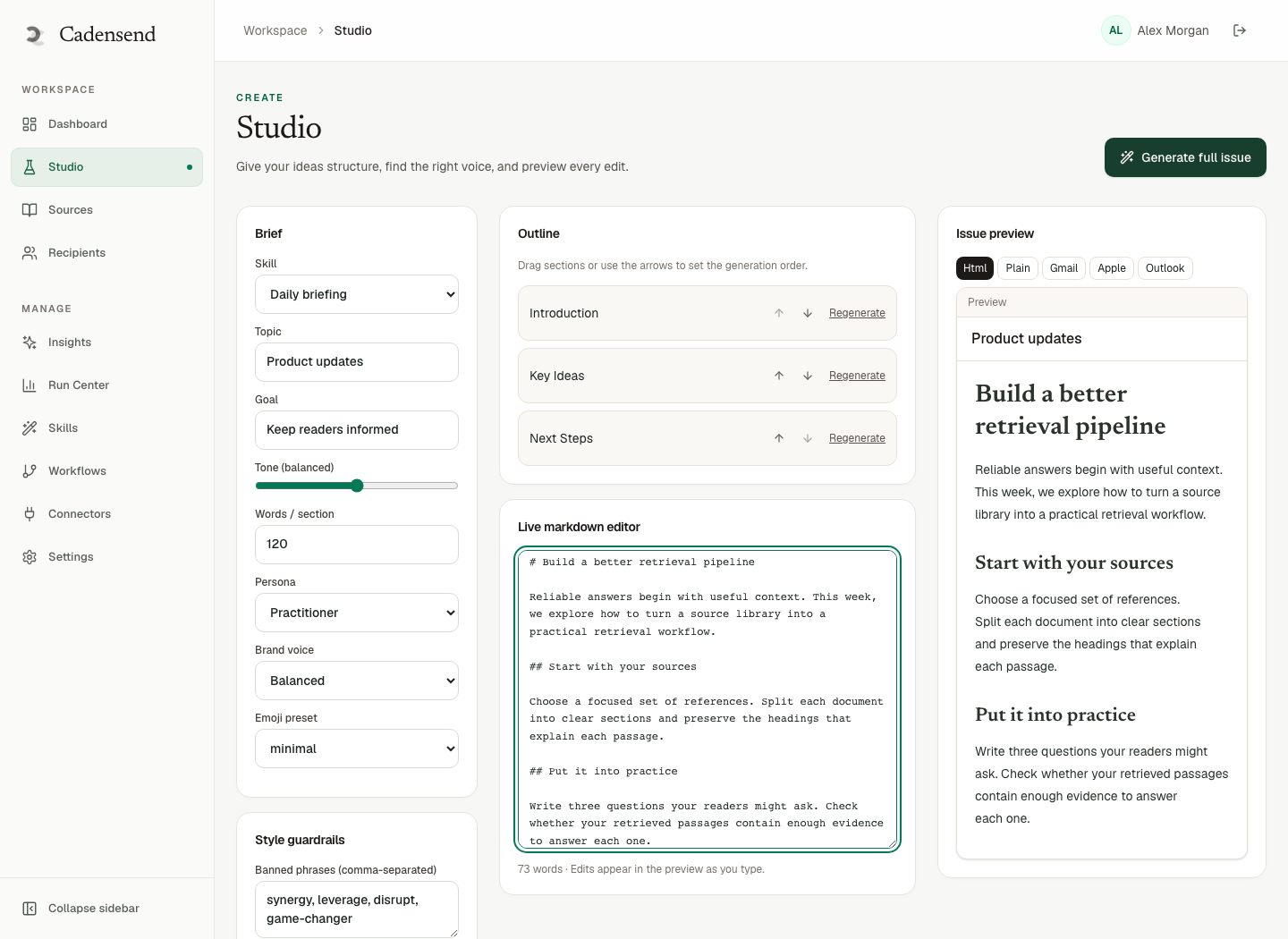
At HinterBuild we use Cadensend — an MIT open-source, self-hosted email curriculum engine — to Plan cadence and issue size, Ground each issue in your sources, Write a bounded content tree, and Deliver once. There is no hosted signup (GitHub). The MVP sends only to your verified address, which is the correct way to test whether your “five-minute” issue is actually five minutes.
Key Takeaways:
- Microlearning in email means one objective, one example, and one retrieval task per issue — not a shorter PDF.
- Binge learning raises short-term familiarity and tanks delayed retrieval; spacing reverses that trade-off.
- Cadence, timezone, and rest days are instructional design, not marketing automation.
- Ground micro-lessons in cited sources so brevity cannot become hallucination.
- Keep a binge artifact as an optional recap, never as the primary path.
- Approve the first send of each issue; a wrong five-minute lesson still teaches the wrong thing 21 times.
Table of Contents:
- What Microlearning Actually Means
- What Binge Learning Does to Memory
- Email as a Spacing Medium
- Issue Size, Time, and Cognitive Load
- When a Binge Packet Is Still Right
- Designing a Microlearning Cadence
- Grounding Short Lessons So They Stay True
- Review, Lock, and Exactly-Once Delivery
- A Side-by-Side Week
- Frequently Asked Questions
What Microlearning Actually Means
Short answer: Microlearning is a complete instructional loop in a small time box, not a tweet-sized fragment of a larger lecture.
If the learner cannot retrieve anything without the next four emails, you did not micro-learn. You serialized a chapter. A usable definition: the issue contains an objective, a short explanation, one example, and a check that would still make sense if the series stopped tomorrow. Reviews of microlearning in workplace and higher-ed settings find gains when the unit is complete and aligned to a task, not when content is merely chopped (Frontiers in Education).
That completeness is why writing learning objectives an AI can plan from comes before cadence. Cadensend’s Plan stage captures topic, included and excluded concepts, outcome, audience level, cadence, timezone, and tone. Those fields exist so the generator cannot “helpfully” stuff three objectives into Monday because the source PDF had a long section.
Microlearning is also not “mobile-first slides.” It is a constraint on scope. The same constraint shows up in a 21-day skill curriculum: cut the profession until a day has one performance.
What Binge Learning Does to Memory
Short answer: Massed practice feels fluent while you are doing it; delayed tests expose the gap. Spacing feels slower and wins later.
Cepeda et al. reviewed decades of distributed-practice data: spreading study over time reliably beats cramming for long-term retention (Psychological Science in the Public Interest). Binge learning is the email equivalent of cramming — a “welcome, here are weeks 1–4” dump, or a Sunday catch-up of four issues.
Fluency during the binge is a trap. Learners recognize terms they cannot produce. Retrieval practice — trying to recall before restudying — is the cheaper, stronger move (Retrieval Practice). An email course that never asks for a two-minute production task is a newsletter with a syllabus attached.
Binge also wrecks prerequisite ordering. When four issues arrive together, learners skip to the interesting one and miss the dependency. Self-paced does not mean unordered.
| Mode | Typical send | What it optimizes | What it costs |
|---|---|---|---|
| Microlearning | 1 issue / day or 3 / week | Delayed retrieval, habit, transfer | Slower “coverage” feeling |
| Binge | Archive, catch-up blast, weekend pack | Short-term familiarity, calendar convenience | Dropped prerequisites, no spacing |
| Hybrid | Daily issues + optional recap PDF | Retrieval plus reference | Extra production work |
Email as a Spacing Medium
Short answer: The inbox already spaces stimuli; your job is to not collapse that spacing with catch-up blasts and 2,000-word issues.
People do not binge email the way they binge a course platform. They open, skim, defer, or delete. That behavior is hostile to novels and friendly to five-to-fifteen-minute loops. If you need a two-hour lab, link out. Do not paste the lab into HTML email. Code in email is a special case of the same rule: the medium punishes bulk.
Cadensend is not a marketing suite, CRM, or bulk-email provider. It turns one learning goal into a structured series and delivers approved issues reliably and only once. That product boundary matches the pedagogy: Deliver is part of teaching. Jobs are claimed from Postgres with FOR UPDATE SKIP LOCKED. The delivery record is written before the provider call so a retry cannot create a second send. Duplicate pedagogy is still a binge, just an accidental one.
Timezone is not cosmetics. Store the UTC instant and the IANA zone so DST does not slide Wednesday’s retrieval into Tuesday night. Cadensend does that by design. Pick a send window the learner can protect — the same honesty you owe a corporate training audience that already lives in Slack.
Issue Size, Time, and Cognitive Load
Short answer: Budget working memory: one new schema, one example, one task. Extra diagrams and optional tools are not “value”; they are load.
Sweller’s cognitive load account is blunt: working memory is limited, so extraneous material competes with the skill (Educational Psychologist). Microlearning fails when “short” still introduces a new CLI, a new mental model, and a new assessment rubric in 400 words.
Practical caps we use when planning email issues:
- Read: 300–500 words of teaching prose.
- Do: 5–15 minutes. If the honest time is 40 minutes, it is not a micro issue.
- New terms: two, defined in the same email.
- Links out: one primary lab or doc, not a resource hoard.
Audience level changes the cap. Beginner vs intermediate email courses should not share a word-count target. Beginners need more worked example and less “as you already know.” Intermediates need contrast cases. Tone still has to be teachable; see tone of voice for educational emails.
Cadensend’s Write path is a bounded agent: retrieve, write, spec visuals, critique, gate, revise within a hard limit. It returns a validated block AST, not raw HTML. That is the same philosophy as structured outputs from LLMs and agentic workflows that actually ship: keep the model inside a schema.
When a Binge Packet Is Still Right
Short answer: Use a binge artifact as reference after retrieval, for travel days, or as a capstone packet — never as the only modality.
There are honest binge use cases:
- Closed-book recap after two weeks of spaced issues.
- Printable checklist for a lab that cannot run on a phone.
- Compliance packet legal wants as a single PDF in addition to daily teaching.
- Offline travel with a clear “do not skip ahead” warning you know half the readers will ignore.
What is not honest: “we will send daily, but here is the whole course in issue zero so you can work ahead.” You just selected binge as the primary path. If the archive is the real course, skip the theater and convert the blog archive on purpose with a new sequence, not a zip of old posts.
For skills like Python for beginners via email, a weekend project can sit after five micro issues that installed the syntax the project needs. The project is transfer, not day one.
Designing a Microlearning Cadence
Short answer: Choose frequency from forgetting, not from your publishing ambition. Three excellent issues beat seven fragments.
Cadence options that survive contact with work:
| Cadence | Best for | Watch-out |
|---|---|---|
| Daily weekday | Habit, language, drills | Weekend gap needs a Monday recap hook |
| 3× / week | Deeper examples, corporate | Do not pack Monday with two issues |
| Weekly | Essays, case studies | Not microlearning unless the task is still small |
| Burst then pause | Cohorts with live office hours | Pause must include a retrieval ping |
Rest is a send you do not make. In a 21-day map, rest days prevent interleaving from becoming noise. Do not “make up” missed days by blasting. That is how microlearning becomes binge learning with extra steps.
Cadensend’s Create Series wizard records cadence and timezone once. Plan Studio lets you reorder and lock issues. If Monday’s issue is locked and you regenerate week two, Monday’s micro-loop should not grow a second objective. That lock is pedagogical version control.
HinterBuild’s about page is the human side of this: we would rather ship a narrow engine than a platform that pretends email is an LMS. If you need retrieval infrastructure behind the lessons, that is RAG and LLM systems work, not a longer email.
Grounding Short Lessons So They Stay True
Short answer: Brevity increases hallucination risk because there is no room to show uncertainty. Citations are the correction.
A 400-word issue that invents a CLI flag is more damaging than a long essay with a hedge, because the learner will copy the flag. Ground every claim. Cadensend’s Ground stage ingests files and URLs with structure-aware chunking, keeps code and tables, and records section anchors. The model returns source and chunk references; a deterministic renderer turns them into links so citations cannot be fabricated.
That is the teaching version of the stack in LLM hallucination causes and fixes and production RAG systems. Retrieved content is data, never instruction. The writer has no arbitrary network or code-execution tool — relevant if your sources include prompt-like text. Pair with system prompt design patterns so the writer’s job is “explain this chunk,” not “be a helpful internet.”
If you are building the writer as an agent, keep it bounded. Our AI agent development work and human-in-the-loop approval gates exist because short, confident emails still need a human “send.”
Review, Lock, and Exactly-Once Delivery
Short answer: Micro does not mean unsupervised. Approve, schedule, send once, and refuse catch-up doubles.
Cadensend’s Run Center lists generating, awaiting review, scheduled, sending, and failed jobs with stable error codes. Use awaiting review as the default. Educational email is not a growth experiment; it is instruction with a stamp.
The MVP sends to your verified address only. Test the micro-loop on yourself: did you finish it before the next meeting? If not, the issue is a binge wearing a short subject line. Later updates on the public roadmap cover opt-in audiences and consent; they are not a hidden bulk mode in the current build.
Idempotency keys on workspace, issue, recipient, and issue version. That is how you keep a restart from double-teaching Tuesday. If you need help wiring this class of system, contact HinterBuild.
A Side-by-Side Week
Short answer: Same skill (“read a JSON error body”), two calendars, two memory outcomes.
Binge week: Monday 2,400-word issue covering JSON, HTTP status mapping, three libraries, and a homework that needs 90 minutes. Learner skims, stars the message, does nothing, feels informed.
Micro week:
- Mon — Status codes you actually branch on (5 min classify three responses).
- Tue — One error JSON schema; name three fields (5 min).
- Wed — Rest or a two-question retrieval ping from Monday.
- Thu — Map one status + body to a user-visible sentence (10 min).
- Fri — Contrast: empty body vs HTML error page (5 min).
Friday’s learner can produce. Monday’s binge learner can recognize. If you are teaching Python beginners, the micro week is the only one that belongs in email.
Frequently Asked Questions
Is microlearning just shorter videos?
No. A 90-second clip that requires four other clips to make sense is still a fragment. Completeness of the loop matters more than duration.
Can I let learners binge if they prefer it?
You can offer a recap packet after they have attempted daily retrieval. If the binge is available on day 0, most people will pick fluency theater over spacing.
How short is too short?
If there is no example and no check, it is a notification. Aim for a loop the learner can finish in 5–15 minutes, including the task.
Does Cadensend force daily sends?
No. You set cadence and timezone in the series brief. Daily is a common teaching choice, not a product requirement. The engine still Plans, Grounds, Writes, and Delivers whatever schedule you approved.
Why can’t I send the micro course to my whole company today?
The current build delivers only to your verified address. That constraint keeps consent and suppression from being bolted on later as a surprise. Cadensend is self-hosted and MIT licensed; it is not a hosted list tool.
What if my subject needs two-hour labs?
Keep labs off-email. Use issues to prepare, debrief, and retrieve. Link the lab. Email is the spacer, not the workshop.
How do I stop catch-up blasts after a holiday?
Do not queue four “missed” issues. Send one recap retrieval issue, then resume the map. Catch-up is binge learning with a polite subject line.
Conclusion
- Microlearning vs binge learning in email is a memory design choice, not a branding choice.
- Complete, cited, 5–15 minute loops beat archives that feel productive.
- Cadence, locks, and exactly-once delivery are part of the pedagogy.
- Test the loop on your own verified inbox before you argue about lists.
Run Cadensend locally, read the source, or book time with HinterBuild. Engineering conversations also happen on LinkedIn.
Free consultation
Book a free consultation call on microlearning via email
30-minute call with the HinterBuild team. Discuss your project, architecture questions, or next steps — no obligation.
Book a meeting
Keep reading
Related articles
Teach Python to Beginners Through Email Courses
Teach Python to beginners with a source-grounded email course: small syntax loops, safe code samples, prerequisites, and a cadence they can finish.
Read post
Design a 21-Day Skill Curriculum That Sticks
Design a 21-day skill curriculum with one outcome, spaced issues, source-grounded lessons, and a delivery cadence you can actually finish.
Read post
Custom GPTs vs Projects vs Email Courses
Custom GPTs vs Projects vs email courses: when to use a chatbot wrapper, a file pack, or a sourced, self-hosted email curriculum you will actually finish.
Read post
Write a 7-Day Email Onboarding Course
Write a 7-day email onboarding course with objectives, sources, and exactly-once delivery — without treating a curriculum engine like a CRM.
Read post