
Prerequisite Ordering for Self-Paced Courses
Design prerequisite ordering for self-paced courses so email issues stay solvable, coverage is complete, and skipped dependencies cannot hide.

Muhammad Abdul Sami
· 12 min read
- Curriculum Design
- Prerequisites
- Email Courses
Prerequisite ordering for self-paced courses is the difference between a learner who is stuck and a learner who is slow. Self-paced does not mean unordered. When issues arrive by email, there is no teacher to notice that day 6 assumed a mental model from day 14. This guide shows how to extract dependencies, validate a plan, handle optional branches, and keep a generator from “helpfully” using syntax you excluded.
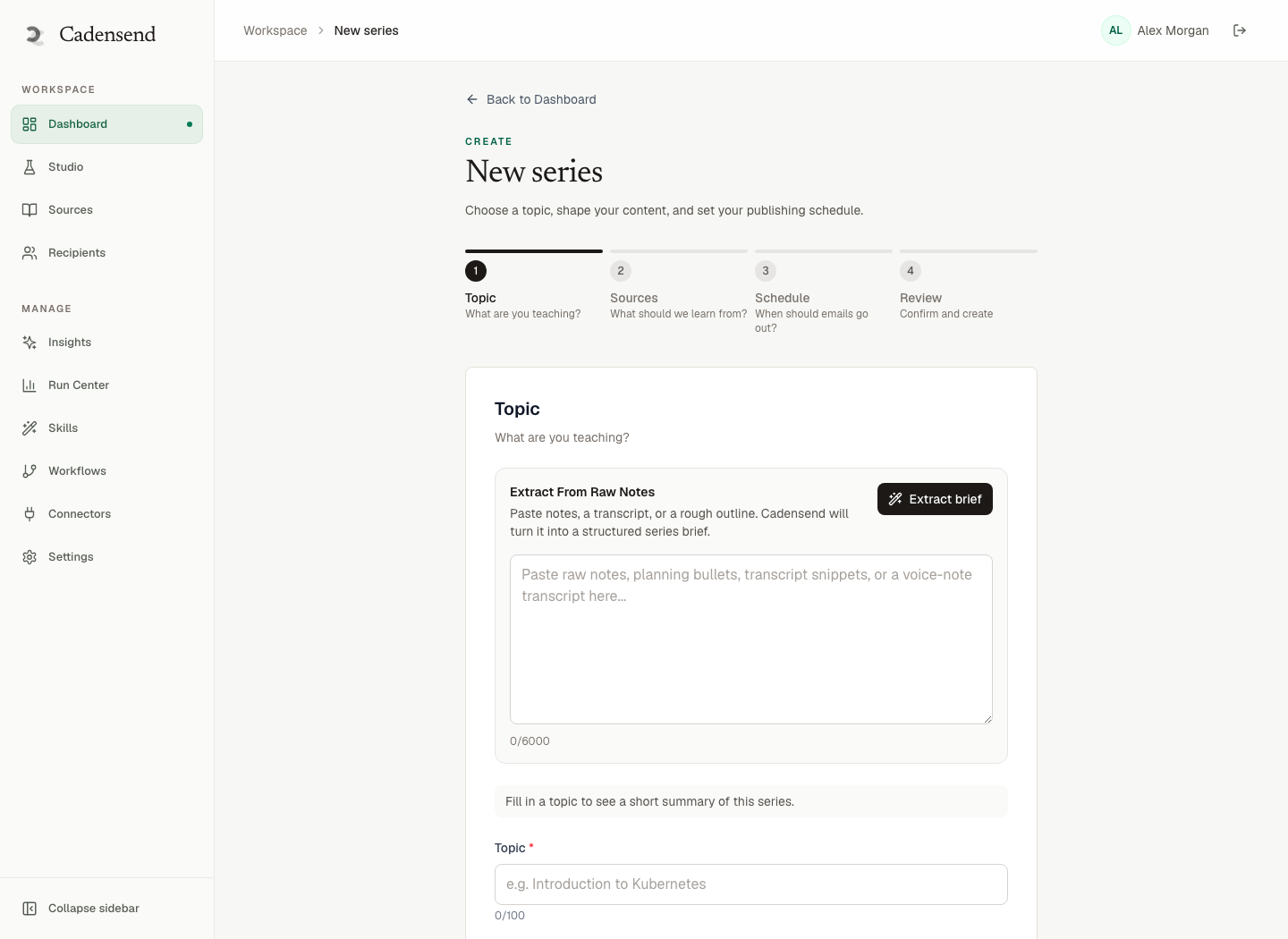
Cadensend treats prerequisite checks as part of Plan, not as a linter you run after 20 drafts exist. HinterBuild’s MIT open-source, self-hosted email curriculum engine turns a learning goal into a structured series: Plan (coverage + prerequisite validation), Ground (your sources), Write (bounded, cited issues), Deliver (exactly once). No hosted signup (GitHub). MVP sends only to your verified address — which is how you will be the person who hits the hidden dependency first.
Key Takeaways:
- Write each issue’s assumes and teaches as data, then sort; do not sort by vibe or blog chronology.
- A cycle in the graph means your objectives are tangled; split the issue.
- Optional extras must not carry required skills; otherwise they are not optional.
- Validate coverage against the terminal performance, not against a topic cloud.
- Lock approved prefixes of the sequence so regeneration cannot reintroduce a skipped concept.
- Ground examples in sources so prerequisites are real APIs, not hallucinated ones.
Table of Contents:
- Self-Paced Is Not Unordered
- Extract Assumes vs Teaches
- Build a Directed Graph You Can Sort
- Coverage Is a Prerequisite of Ordering
- Optional, Remedial, and Parallel Tracks
- Audience Level Changes the Edges
- Let a Planner Validate, Then Lock
- Grounding Stops Fake Prerequisites
- Worked Map: From HTTP to Webhooks
- Freeze Tests and SME Interviews
- Frequently Asked Questions
Self-Paced Is Not Unordered
Short answer: Learners control when. You still control what must already be true.
Live cohorts hide bad order because a instructor patches in Slack. Email cannot. If you also offer a binge ZIP “for people who want to work ahead,” you silently invite them to skip edges. That is why microlearning vs binge is a prerequisite article for this one: the send cadence enforces order only if you refuse catch-up blasts.
Corporate programs make the same mistake with “all modules available on day 0” in an LMS. Availability is not pedagogy. See corporate training by email without an LMS for the record-vs-teach split.
Constructive alignment (outcomes, tasks, instruction pointing at the same performance) fails if issue tasks require untaught moves (Biggs on constructive alignment). Order is alignment in time.
Extract Assumes vs Teaches
Short answer: Every issue gets two lists. If a token appears in assumes and never in an earlier teaches, you have a bug.
Example for a Python beginner email course:
Issue: for loops
- Teaches:
for item in iterable:, indentation body, loop variable scope at a practical level. - Assumes: lists or another iterable already introduced;
print; assignment.
If the sample uses enumerate, that is a new teach or it does not belong. Generators love enumerate because it looks professional. Beginners experience it as magic.
Do this in a table before prose:
| Issue | Teaches | Assumes | Forbidden (exclusions) |
|---|---|---|---|
| 1 | REPL, + | none | files, pip |
| 2 | names | REPL | classes |
| 3 | if | names, bool | comprehensions |
| 4 | for | lists | while unless taught |
Exclusions are prerequisites in negative form. Cadensend’s Create Series wizard captures included and excluded concepts for this reason. Put no pandas in the brief if the outcome is a 15-line script. Otherwise week two grows a dataframe because your blog archive mentioned it.
Objectives language must be precise enough to make these lists obvious — learning objectives an AI can plan. Bloom verbs help (Vanderbilt).
Build a Directed Graph You Can Sort
Short answer: Issues are nodes; “must precede” is a directed edge. If you cannot topological-sort, split nodes.
Cycles look like:
- Issue A uses a function to motivate lists.
- Issue B uses a list to motivate functions.
- Both claim to be “introduction.”
Fix: tiny list literals before def, or functions that only take numbers. Do not write a poetic cycle and call it “spiral curriculum” unless each visit is explicitly labeled as a revisit. Spiral is reappearance of an already taught idea, not an excuse for mutual dependence. Reappearance belongs in a 21-day skill curriculum as retrieval, with the edge already satisfied.
| Pattern | Valid? | Notes |
|---|---|---|
| A → B → C | Yes | Linear skill |
| A → B, A → C | Yes | Parallel after shared base |
| A ↔ B | No | Split or pick a base |
| A → C skipping B when B taught C’s primitive | No | Hidden skip |
This is the same hygiene as agentic workflows: implicit edges become production incidents. Here the incident is a learner who thinks they are bad at the subject.
Coverage Is a Prerequisite of Ordering
Short answer: A perfect order of the wrong set still fails the outcome. Validate coverage first, order second.
If the terminal performance needs “explain a dropped row,” some issue must teach INNER vs LEFT. Ordering that issue after the capstone is an order bug; omitting it is a coverage bug. Cadensend’s Plan checks both, with a revision pass when validation fails.
Backward design still applies (Understanding by Design). List the capstone rubric. Highlight tokens. Each highlighted token must have a first-teach issue.
Retrieval practice should reuse taught tokens, not smuggle new ones (Retrieval Practice). Mixed quizzes in week three are for discrimination, not for surprise APIs.
Optional, Remedial, and Parallel Tracks
Short answer: Optional means skippable without failing the capstone. If skipping it makes issue 9 impossible, it is required — move it onto the main path.
Remedial issues: “if Monday’s traceback confused you, this extra send.” In email, extras are dangerous because they desynchronize the calendar. Prefer a link to a labeled appendix over a new cadence. Cadensend’s later roadmap mentions branching paths for learning businesses; the MVP is a linear, validated series. Do not fake branches by sending two issues the same morning.
Parallel tracks (backend vs platform) need a join issue that does not assume both. Staff engineers and new grads often need two series, not one clever graph — beginner vs intermediate email courses.
Audience Level Changes the Edges
Short answer: Intermediates have unofficial prerequisites in their heads. Beginners do not. Name them.
“You already know git” is an edge. Put it in the series entry requirement or teach it. Silent amateur edges are how self-paced courses feel elitist without meaning to. Tone of voice should not say “obviously” about an unlisted prerequisite.
For intermediate tracks, edges might be “can read a stack trace” rather than “has seen print.” Still write them down. Cadensend’s audience-level field is not decorative; it changes which assumes are legal.
Let a Planner Validate, Then Lock
Short answer: Generate the plan as structured data, fail the validator, revise, then lock the prefix you approved.
Cadensend uses a LangGraph planning graph separate from issue Write. That split is system prompt design plus structured output: the plan is inspectable. Plan Studio reorders, edits objectives, and locks approved issues so they survive regeneration of the rest.
Human review is still required. Validators catch missing edges; they do not catch “this example is technically ordered but pedagogically cruel.” Human-in-the-loop approval gates apply before Deliver. Run Center includes awaiting review.
If you are building an in-house planner, HinterBuild’s AI agent development stance is the same: bounded graphs, revision caps, no open-ended “keep fixing the syllabus forever.”
Grounding Stops Fake Prerequisites
Short answer: Ungrounded examples introduce APIs that were never in teaches because the model has seen them on the internet.
That is a hallucination that looks like an ordering bug. Cadensend Ground retrieves from your files and URLs, preserves code, stores section anchors, and cites through a deterministic renderer. Retrieval is series-scoped. The writer cannot browse or execute.
If you convert a blog archive, old posts will constantly smuggle prerequisites (“as we did with Kubernetes…”). Exclusions + scoped sources are the fix. Production RAG systems use the same scoped retrieval idea.
Deliver still matters: a retry must not send two versions of issue 4 with different hidden assumes. Cadensend keys sends on workspace, issue, recipient, and issue version, writing the record before the provider call. Postgres FOR UPDATE SKIP LOCKED is the queue. Timezones stay attached so “self-paced” is not “whenever DST shifted.”
MVP: you receive the series. When issue 5 is impossible, the graph is wrong. Fix the plan before you fantasize about cohorts.
Cadensend is free (MIT); you pay LLM, mail, infra. No hosted product to dump learner PII into. HinterBuild (about) will talk through graph design if your domain’s dependency mess is the actual project.
Worked Map: From HTTP to Webhooks
Short answer: Notice the fake optional and the cycle, then the repaired order.
Broken list (looks reasonable in a meeting):
- Webhooks in production
- HTTP verbs
- Signing payloads
- Idempotency
- What is HTTP
Issue 1 assumed 2 and 5. Issue 3 assumed 4 for a “good” example. Cycle between signing and idempotency depending on the sample.
Repaired:
| # | Teaches | Assumes |
|---|---|---|
| 1 | HTTP request anatomy | none for this series |
| 2 | Verbs and status classes | 1 |
| 3 | Idempotent retries at a conceptual level | 2 |
| 4 | Recap retrieval | 1–3 |
| 5 | Webhook as inbound HTTP | 2 |
| 6 | Signatures as authenticity, not as crypto math | 5 |
| 7 | Provider retries + your idempotency key | 3, 6 |
| 8 | Capstone: debug a double-charge story | 7 |
Code samples, if any, follow email-safe code rules. No SDK that implies issue 9’s framework.
Freeze Tests and SME Interviews
Short answer: A freeze test is you (or a colleague who matches the audience priors) attempting issue N with only issues 1…N−1 available. An SME interview is how you find assumes the expert cannot see.
Freeze test protocol:
- Lock issues 1…k in Plan Studio.
- Send them, in order, to the verified address — Cadensend’s MVP scope is exactly this.
- Do not open issue k+1, the blog, or Slack.
- Attempt the retrieval task. Time it.
- Log every token you needed that was not in teaches. Those tokens are missing edges or missing exclusions.
If the freeze test needs a library that the brief excluded, the writer hallucinated a prerequisite. Fix Ground and the plan, not the learner. This is cheaper than a cohort. It is also why microlearning cadence beats a ZIP: you cannot accidentally read ahead if it has not arrived.
SME interview questions (record the answers as assumes/teaches rows, not as vibes):
- “What would make this sample illegal in week one?”
- “Which error do newcomers hit that you no longer see?”
- “What do you skip saying because it feels obvious?”
- “If we have 12 issues, which two can die?”
The last question fights coverage bloat. Experts add “just one more realistic detail.” Realistic details are often extra edges. Put them in the intermediate series, not in the beginner graph — see beginner vs intermediate.
When SMEs contradict each other, the brief owner decides. Cadensend will not mediate politics. Write the exclusion. Lock issue 1 so the losing SME cannot win via regeneration. Tone should not leak the argument into the learner’s inbox.
If the domain is messy enough that freeze tests always fail, you do not have a sequence yet. You have a wiki. Convert it with the blog-archive method or stop claiming it is self-paced.
Frequently Asked Questions
Can learners skip around if they are advanced?
Only if you publish an entry test that maps to named prerequisites. Silent skip is how intermediates miss the one issue that was not actually review.
How many prerequisites per issue?
One primary new teach. Assumes can be many, but they must all be prior teaches. If assumes > 5, you are probably at a capstone — label it.
Does Cadensend auto-fix order?
It validates coverage and prerequisite ordering and can run a revision pass. You still inspect in Plan Studio and approve. It will not silently ship a broken graph.
What if my subject is naturally tangled?
Split issues until edges are one-way, then use later mixed practice to recombine. Tangled is not a personality; it is unfactored objectives.
Should I show the graph to learners?
A simple “before this issue, you should have finished 1–4” is enough. A full graph viz is for authors.
How does delivery interact with prerequisites?
Exactly-once, in-order scheduling protects the graph. Catch-up blasts and unlocked regenerations destroy it. MVP send is your verified address so you can feel the graph.
Can I branch in the current Cadensend build?
The MVP is a linear structured series. Branching paths are a later learning-business update. Use two series with an entry gate instead of a fake branch.
Conclusion
- Self-paced courses still need a directed prerequisite graph with explicit assumes/teaches.
- Validate coverage, sort, forbid optional issues from carrying required skills, lock the prefix.
- Ground examples so the internet cannot insert extra edges.
- Dogfood the order on one inbox; do not bulk-send a graph you have not walked.
Use Cadensend to Plan that graph, or contact HinterBuild. Team: LinkedIn.
Free consultation
Book a free consultation call on course prerequisite design
30-minute call with the HinterBuild team. Discuss your project, architecture questions, or next steps — no obligation.
Book a meeting
Keep reading
Related articles
Turn PDF Notes Into an Email Course
Turn PDF notes into an email course: ingest documents, plan modules, ground every claim, and schedule issues with real citations.
Read post
Daily Email Course: Learn Anything From Sources
Build a daily email course from one learning goal and your own sources. Plan modules, cite claims, and deliver each issue exactly once.
Read post
Design a 21-Day Skill Curriculum That Sticks
Design a 21-day skill curriculum with one outcome, spaced issues, source-grounded lessons, and a delivery cadence you can actually finish.
Read post
Corporate Training by Email Without an LMS
Run corporate training by email without an LMS: scoped curricula, source-grounded issues, human review, and honest limits vs compliance platforms.
Read post